This article is an updated version of one originally published November 9, 2018.
I know the day I got on renown marketing consultant Mark Schaefer’s radar: October 25, 2017.
My former client Dan Levine mentioned Mark to me earlier that year (thanks Dan!). I sent Mark a message on Twitter with a question on July 3, 2017. He was kind enough to respond, though he did not know me.
That kindness prompted me to look up his website, to sign up for his blog, and to buy his book Known.
I read the book in September. On October 6, 2017, I sent him a handwritten thank you note for writing the book, detailing what I got out of it.
On October 25, 2017, Mark messaged me on LinkedIn to thank me for my thank you note. He said it was a nice surprise. Now he knew who I was.
Over the next 16 months, I read two more of Mark’s books, The Tao of Twitter and Marketing Rebellion, and handwrote thank you notes for both.
When Mark created The Uprising, a retreat for marketing leaders limited to 30 people, he sent me an early invitation before opening it to the public.
When I arrived at The Uprising on September 30, 2019, he greeted me like an old friend and gave me a bear hug.
In August 2020, Mark hired me to be an editor on his book Cumulative Advantage.
In three years, I went from obscurity to having Mark as a client. Mark has since hired me to edit two other books for him.
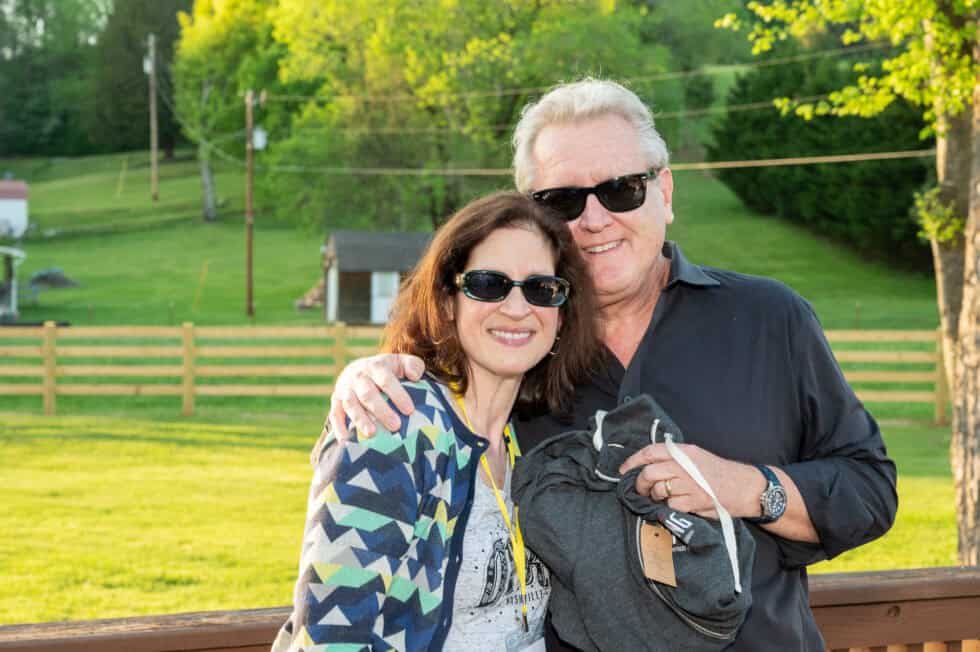
Evelyn Starr and Mark Schaefer, Photo credit: Alex Ledesma
I did not know all this would happen when I wrote that first thank you note to Mark. Authors put a ton of work and heart into their books. I like sending thank you notes to authors I enjoy. It lets them know someone appreciated their creation.
I handwrite thank you notes often. I don’t expect business to come from them and I never ask for anything. My focus is on expressing gratitude and building a relationship.
As you can see from my interaction with Mark, handwritten thank you notes are relationship-building power houses. They get you on someone’s radar fast and keep you there. I have seen them displayed in clients’ offices when I visit.
What makes handwritten thank you notes so powerful? And why are they better than thank you emails?
First, they stand out. According to technology research firm The Radicati Group, office workers receive an average of 97 emails per day. By contrast, the average American household receives just 10 pieces of personal mail per year, not counting holiday cards and invitations. While email inboxes overflow, a handwritten envelope in the mail grabs attention.
Second, they show you care. A handwritten thank you note represents thought and effort on the part of the sender.
Third, they elicit a positive emotional response from the recipient. Saeideh Heshmati, Assistant Professor of Psychology at Claremont Graduate University led a study on what makes people “feel loved.” Among the findings were “small gestures in everyday life” like people showing support without expecting anything back.
You’ve heard that the best brands establish an emotional connection in their marketing. Business owners often focus on the wording of their tagline or the storyline of their ads to do this, and that is important.
A handwritten thank you note can be even more effective.
About now you may be thinking “Well that’s all good but my time is limited. What’s the return on investment (ROI) on handwritten thank you notes? Do they scale beyond the single recipient?”
While exact results will vary by brand, handwritten notes’ ROI comes in the form of customer retention, repeat business, and word-of-mouth marketing.
Wufoo, an online form-building company, takes time every week to send handwritten thank you cards to customers. Customer Ops team leader Renee Morris reports that “out of the roughly 800 customers who received handwritten cards from us last year, 50% fewer folks left our product than those who did not receive cards.”
A 50 percent better retention rate means steadier revenue.
Online non-profit firm Donors Choose makes it easy for donors to help classrooms in need. Founder Charles Best conducted a study to measure the ROI of gratitude. He had his staff send handwritten thank you notes to half of their first-time donors. The other half received no thank you notes. The group who received the thank you notes were 38 percent more likely to donate again.
Handwritten thank you notes can increase the likelihood of repeat purchase or donation.
Beyond customer retention and repeat business benefits, handwritten thank you notes can generate positive word-of-mouth. Thanks to social media, that can scale to thousands of people.
I experienced this first hand when brand expert Denise Lee Yohn raved about a handwritten thank you note I sent her on Twitter. Denise has 17,100 followers.
My own experience supports the business case for handwritten notes. Thank-you-note-recipient referrals have led to six speaking engagements, twelve new clients, thirty-three research and consulting projects, one coaching engagement, four book editing gigs, and a three-year consulting stint on retainer.
I hope you can see now that handwriting thank you notes is a powerful marketing tool.
But the benefits don’t stop at your brand.
Handwriting thank you notes not only makes your recipient feel good, it can make you feel happier too.
Associate Professor of Human Development Steven Toepfer at Kent State University conducted a study where the participants were asked to write three “letters of gratitude” over the course of a month. Results showed that after each letter participants experienced higher levels of happiness and lower levels of depressive symptoms.
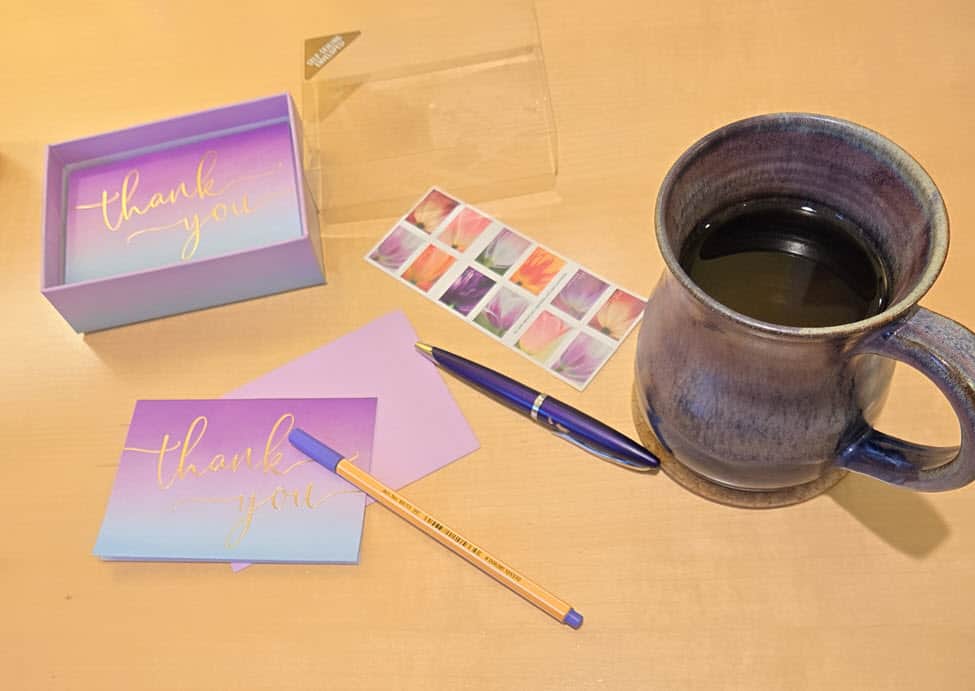
Scene on my desk several times a month
There is no downside to handwriting thank you notes and the upside benefits you and your business. The trick is to work it into your routine.
To get started:
I hope you enjoy writing thank you notes as much as I do!
***
I was yesterday years old when I learned January 11 is International Thank You Note Day.
Also when I learned Jimmy Fallon writes thank you notes weekly on The Tonight Show.
Read some of his funniest ones. (2 minute read)
Read 6 famous thank you letters. Senders include Neil Armstrong, David Bowie, Roald Dahl, Johnny Depp, Ronald Reagan, and Rowan and Martin. (3 minute read)
Enjoy!
Two days before my daughter Fiona’s bat mitzvah in June 2013, my mother-in-law’s cousin Beth dropped off a beautifully-wrapped, 3 ½-inch square box.
Inside were two Alex and Ani bracelets. One charm had a script initial F, the other had a Jewish star.
I had never heard of Alex and Ani. But Fiona’s face lit up. Her excitement told me our 70-something cousin had nailed the gift.
Like anything you suddenly become aware of, I started to see Alex and Ani bracelets everywhere.
Friends of Fiona and other teenage girls had clusters of them piled on their wrists.
Alex and Ani opened a store near us in Wellesley, Massachusetts, an upscale Boston suburb. Fiona and I accompanied my son AJ when he went there to get a sweet 16 gift for a friend.
The store was an experience. Enthusiastic salespeople, all late-teen or 20-something women, greeted us warmly, asked our purpose, and offered help.
They wanted to know if the gift recipient believed in the transformative power of jewelry.
Display cases ran the perimeter of the small, rectangular shop, and contained bracelets with charms for every possible identity marker a woman could imagine: daughter, mom, grandmother, best friend, every initial in the alphabet, Red Sox fan, Yankee fan, insert-your-sports-team-here fan.
Other charms were emblems, like the tree of life and the Claddagh, which symbolizes love, loyalty, and friendship. Bracelets cost $30-$40 each.
The store’s aura, enthusiastic salespeople, meaningful charms, and affordable prices explained why these simple bangles were so popular among teenage girls.
Wellesley seemed to be a good market for them. I was surprised when the shop closed less than three years later.
Carolyn Rafaelian was granted a patent on “an expandable wire bangle bracelet” on March 23, 2004. The simple design put the focus on the charm that adorned it.
Having recently taken over Cinerama, Inc., her father’s costume jewelry factory in Cranston, Rhode Island, Rafaelian started a company to market her bracelets. She named it after her two eldest daughters, Alex and Ani.
Rafaelian understood that women chose jewelry to reflect their persona, to express who they are and who they aspire to be.
For this reason, she sought to infuse her charms with “positive energy” and studied symbols and runes.
The messages of well-being, empowerment, and uplift made Rafaelian’s creations irresistible to customers and flavored the brand’s early culture.
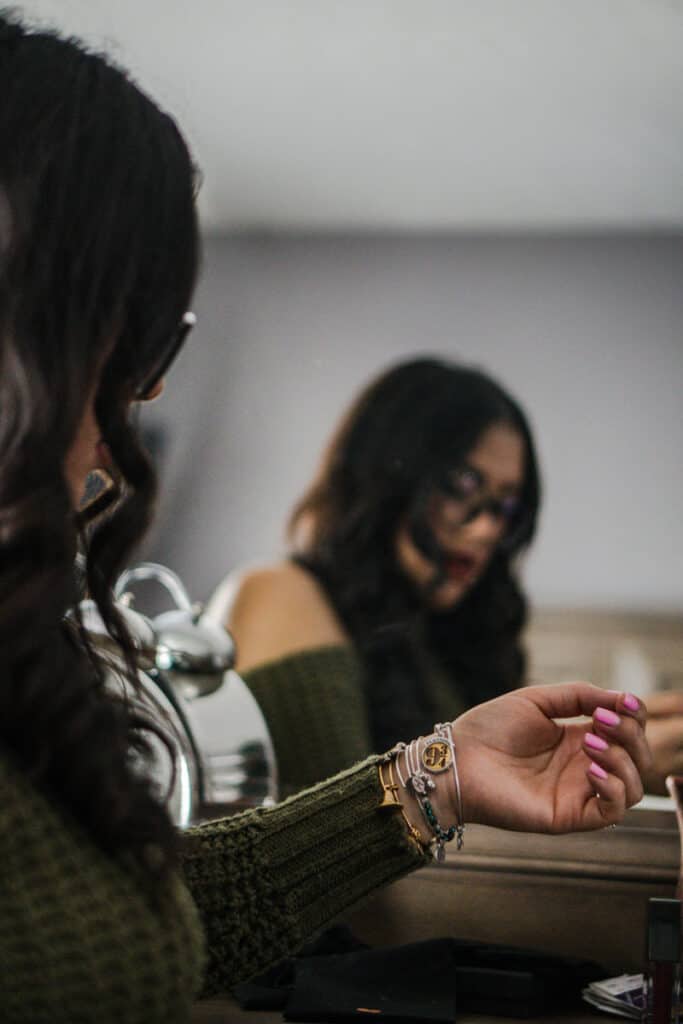
Photo by Marcus Bellamy on Unsplash
Rafaelian also proved a savvy and creative marketer.
In 2004, she sent Gwyneth Paltrow a bangle with an apple charm to congratulate her on the birth of her daughter, Apple. Images of Paltrow wearing the bangle gave Alex and Ani an immediate boost.
Alex and Ani gained other celebrity fans like Anne Hathaway, Miley Cyrus, and Sandra Bullock.
Sales grew from $654,000 in 2006 to $2.2 million in 2009, the year Alex and Ani opened their first store, in Newport, Rhode Island.
As a leader, Rafaelian leaned into spirituality, using astrology, Biblical Numerology and New Age practices like tarot card readings to make business decisions.
After meeting Giovanni Feroce at a University of Rhode Island alumni homecoming event in October 2009, Rafaelian hired him as CEO in April 2010. She took the role of Chief Creative Officer.
Feroce was a former elite Army officer. He insisted on complete operational control.
Feroce struck deals with Saks Fifth Avenue and other department stores. He inked licensing agreements with Walt Disney, the National Football League, and the Marines.
Alex and Ani enjoyed distribution through hundreds of mom-and-pop jewelry stores, and opened nearly 40 branded stores like the one in Wellesley.
Sales soared from $4.5 million in 2010 to $230 million in 2013. The employee count reached 1,084 by the end of 2013.
In 2012, JH Partners, a San Francisco private-equity firm, purchased a 40 percent holding in Alex and Ani for $50 million.
On March 13, 2014, Feroce suddenly left the company.
Feroce told The Providence Journal his departure came over a difference with Rafaelian over how fast the brand should grow.
Feroce envisioned making Alex and Ani a lifestyle brand – think apparel, home goods, perfume, accessories, like Ralph Lauren or Michael Kors. He wanted to hire a team of designers to speed development.
A former executive said Rafaelian pushed him out, along with anyone loyal to him.
The exodus drained management and included the chief financial officer, chief technical officer, chief strategy officer, chief digital officer, acting chief operating officer, assistant general counsel and VPs of retail, wholesale, and transitional operations.
Though Rafaelian declined to comment, she had told The Providence Journal in July 2012 “The company’s an extension of me.”
My guess is Feroce’s desire to bring in a design team for other lifestyle product lines threatened Rafaelian’s view of the brand as an extension of herself. She could not give up control.
Rafaelian retook the reins as CEO, and never let go.
She continued her New Age and spiritual practices, burning sage to purge areas of bad energy and having shamans bless product inventory.
Sales reached $350 million in 2014.
In December 2014, JH Partners sold their 40-percent stake to British buyout firm Lion Capital LLP for $400 million.
That transaction effectively valued Alex and Ani at $1 billion.
With Lion Capital’s investment, talk of an initial public offering began. Professional management sought to reduce costs.
I’m betting the Wellesley store’s high rent was a casualty of the cost cutting and the reason it closed in early 2016.
Alex and Ani took a $170 million loan from Bank of America (BOA) in 2016 to buy Cinerama, Inc. from Rafaelian and her sister. Acquiring the factory was seen as vertical integration move.
Rafaelian hired presidents, but undermined them. Harlan Kent, former CEO of Yankee Candle, lasted less than a year.
His successor, Cindy DiPietrantonio, left after two years in December 2017.
From the outside, Alex and Ani seemed to chime along, finishing 2017 with $550 million in sales. Rafaelian graced the cover of Forbes magazine as the poster girl for women billionaires.
Inside, however, turmoil reigned.
The brand lost much institutional knowledge with the top management exodus and struggled to maintain retail relationships. Alex and Ani closed stores, endured rounds of layoffs, and cut digital marketing and event budgets.
Employees who had loved working there now feared for their jobs.
Rafaelian hired a new CFO and tried to run the brand herself. She told a Forbes reporter, “I don’t listen, which is the best thing I do.”
The brand’s belt-tightening included a new direct-to-consumer strategy in 2018, aiming to have 75-80% of sales go through the company website or company stores within 18 months.
Mom-and-pop jewelry stores that helped build the brand were cut off. Retailers felt abandoned.
Sales dipped to $500 million for 2018. Interest in the bangles was waning. Earnings (EBITDA) plummeted to less than $10 million.
When BOA saw the earnings, they held the company in default of their loan and moved to liquidate it.
Lion Capital struck an agreement with BOA to prevent liquidation, which stipulated Rafaelian had to give up her controlling interest in the company.
Lion Capital brought in a new CEO, Bob Trabucco, but the ship was sinking fast. Sales were down 40% in the fourth quarter of 2019 compared to 2018 and continued to tank.
Pandemic-induced store closings exacerbated the situation. Alex and Ani terminated Rafaelian’s employment in 2020 and filed for bankruptcy in 2021.
While some companies manage to rebuild during bankruptcy, Alex and Ani is swirling down the drain.
At the beginning of 2023, the company had 38 stores in the US. In June 2023, they closed 21 stores and their corporate headquarters overnight, leaving them with only 7 stores and no presence in their home state of Rhode Island.
Employees and store managers were shocked.
Equipment and furnishings left behind were auctioned off in November 2023.
Multiple creditors claimed unpaid bills.
Among them, Alex and Ani owed the town of East Greenwich, RI over $251,000 in back taxes, their corporate-office landlord nearly $458,000 in rent, and a local videographer $1,500 for video production.
It’s ironic and sad that Alex and Ani’s website recently launched a line of pearl products called “Stranded by Alex and Ani.” That’s how their employees and creditors felt.
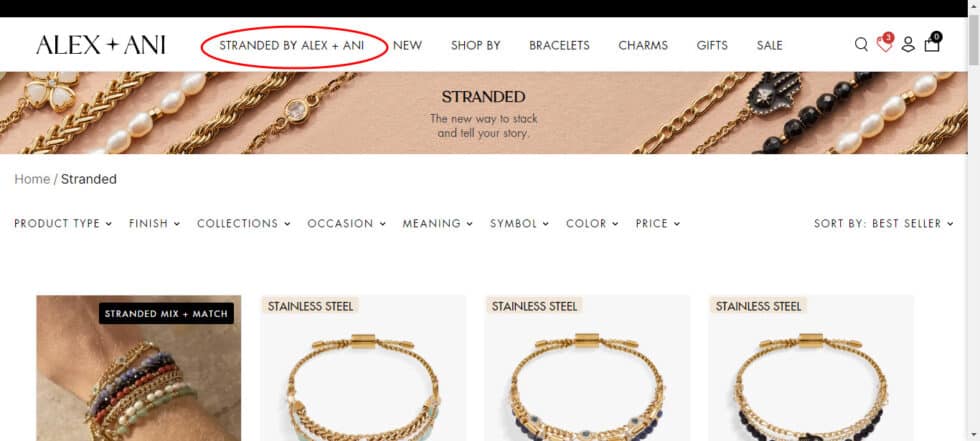
How did a brand worth a billion sink to beans?
First, Alex and Ani’s founder could not step back when her leadership was no longer relevant.
In my book Teenage Wastebrand: How Your Brand Can Stop Struggling and Start Scaling, the diciest brand adolescent symptom I discovered was asserting independence.
Brands assert independence when they outgrow their founder’s skillset. The symptom is dicey because founders often fail to realize the situation or choose to ignore it.
Rafaelian ignored it.
Rafaelian’s insights on jewelry and spiritual leadership gave Alex and Ani a great start, but the brand needed professional leadership to grow. Rafaelian saw that and hired Feroce. He and his team grew the brand exponentially.
But she pushed him and the presidents who succeeded him out.
When Rafaelian tried to preside, the brand declined. Waning consumer interest and pandemic store closures turned the decline into a freefall.
Second, the founder’s hubris and conflicts of interest drained the company.
Rafaelian’s swift retribution against Feroce’s management team deprived the brand of relationships and institutional know-how. The company went from well-oiled machine to scrambling.
Rafaelian prioritized her control over the brand’s health.
True to her word, she didn’t listen to the presidents she hired and undermined them, depriving the company of professional leadership.
The loan to purchase the factory she owned burdened the company financially and put it at risk. Yet she entered the loan, which she stood to benefit from.
When BOA ruled the loan in default, it nearly killed the company. Rafaelian risked the company’s viability to fill her personal coffers.
Third, management chaos and investor-prompted cost-cutting alienated Alex and Ani’s constituents and commoditized the brand.
Waves of layoffs strained the company’s ability to operate, stranded thousands of employees, and demoralized those who remained.
Alex and Ani’s partners struggled to communicate with the company as their contacts were suddenly gone. When the brand became unreliable, they cut ties.
Mom-and-pop stores that provided the kind of personal selling that promoted Alex and Ani’s aura were cut off in favor of direct selling. As company stores closed, the brand lost many of its strongest advocates.
Alex and Ani’s website could not present the brand the way an informed salesperson could. The brand lost its meaning and differentiation.
Fourth, the brand failed to diversify.
The Alex and Ani brand stood for empowerment, wellness, and uplift. Feroce was right to look to expand beyond jewelry. When interest in the bangles waned, customers had nothing else to keep them engaged with the brand.
Alex and Ani succumbed to brand adolescence and is unlikely to recover.
If you are the founder, your brand’s survival depends on your ability to lead or find someone who can.
Reid Hoffman (LinkedIn) and Clay Collins (LeadPages) shared their thinking when they decided to step down as CEO. You can see their thoughts and find questions to help you assess your CEO fitness here.
JH Partners were the big money winners. They turned $50 million to $400 million in two years and got out while things were good.
Carolyn Rafaelian had her net worth plummet from $1 Billion to $100 million and had to sell some of her properties. She started two other jewelry companies.
As for Fiona, she has not worn her Alex and Ani bracelets in years. She said they became annoying because they clanked loudly and banged against the desk when she wrote.
It speaks volumes that she left her collection at home, thousands of miles from where she is in grad school.
Did you know anyone with an Alex and Ani bracelet or own one yourself?
***
Saalt’s humor introduces teen girls, women and yes, even dad, to their period cup. (4 minutes, 34 seconds)
SNL mocks the charm-as-identity-marker gift giving. (1 minute, 34 seconds)
What Vincent Van Gogh and Frida Kahlo might endure if they had to cater to corporate interests (2 minutes, 44 seconds, h/t Rohit Bhargava)
I spent some quality time with David Sedaris a couple of weeks ago.
David Sedaris is a renown writer and humorist who has authored 12 books.
He tours regularly, reading his essays and gauging audience reactions. His book tours are famous for their long book signing lines. He enjoys chatting with each reader and often asks them questions.
David Sedaris shared how he turns observations into stories and that it often takes him weeks to find an opening sentence he is happy with.
He and I spent 3 hours and 23 minutes together.
But he has no idea who I am.
Our visit came courtesy of Masterclass.
Masterclass is an online learning platform that features celebrities and renown experts teaching courses in their specialty.
My friend Ira gifted me a 14-day guest trial pass (thanks Ira!). I took David Sedaris’s Storytelling and Humor course.
As I looked at the 14-day trial offer and entered my credit card, I noticed the annual membership was $120 per year.
I remembered it being $180 during the first year of the pandemic when Masterclass ads popped up daily in my Facebook feed.
I wondered “why would they lower their price?”
Widespread internet access and the high cost of higher education in the US gave rise to a host of online learning companies.
In 2002, Lynda Weinman shifted her educational company Lynda.com from in-person webinars to online courses featuring video instruction. Online video was new then. It took a while for students to adapt to it.
But adapt they did. Lynda.com grew to offer over 6,300 courses. Weinman sold it to LinkedIn in May 2015 for $1.5 billion.
Most of the other well-known online learning players launched between 2010 and 2012: Udemy (2010), Skillshare (2011), Coursera (2012), and Udacity (2012).
Masterclass appeared in May 2015, just as Weinman was cashing in.
Like any party late-comer seeking attention, Masterclass stands out with a key difference: celebrity instructors. Their tagline: “Learn from the best, be your best.”
Founders David Rogier and Aaron Rasmussen launched with 3 classes: Serena Williams teaching tennis; Dustin Hoffman teaching acting; and best-selling author James Patterson teaching writing.
Each instructor reportedly received $100,000 plus 30% of the revenue from their class.
Masterclass also invested in professional video production and set design for each course.
Classes sold for $90 each. Each class package included 10-25 videos, learning materials, interactive exercises (between students), and lifetime access.
Over 30,000 people bought Masterclass courses within the first 4 months.
Masterclass added dozens of courses each year and began offering annual subscriptions for unlimited course viewing at $180 in 2018, removing the $90-for-one-class option.
During the early part of the pandemic, you couldn’t go on Facebook, Instagram, or YouTube without seeing at least one Masterclass ad.
The heavy ad spending worked. Masterclass capitalized on the captive audience, doubling revenues from 2019 ($44.5 million) to 2020 ($88.9 million), and adding another $29.9 million in 2021.
But when the world reopened and people began returning to workplaces in 2022, annual revenue fell to $94.9 million, a $23.9 million decrease.
Since inception, Masterclass has raised $460 million in venture capital. Not yet profitable, the revenue backslide likely made investors antsy. Subscriptions provide all of Masterclass’s revenue.
In May 2022 the company laid off 120 of their 600 workers.
While layoffs reduced cost, Masterclass’s survival requires raising revenues which means increasing subscriptions.
Now 8 years old, Masterclass has hit brand adolescence as it struggles to grow.
In May 2023, Masterclass cut its individual annual subscription plan price by a third, from $180 to $120.
In a statement announcing the price drop, David Rogier, Masterclass Founder & CEO said, “By continuing to innovate the approach to our portfolio of content and making the platform more accessible, we’re not only unlocking potential in our members, we’re enabling them to realize it.”
I don’t know what that means.
It’s a jargon-filled declaration. Was the potential of members locked at $180?
The “more accessible” part I get. It’s the basic economic model we learned in school. You lower the price, more people buy.
I’m guessing Masterclass looked at their competitors, saw them offering free classes and cheaper individual courses (Udemy), and felt compelled to lower their subscription fee.
Antsy investors added pressure to sign more subscribers quickly.
Perhaps their smaller number of course offerings also pushed them to the lower annual fee.
But on an annual fee basis, they were already at the low end with the $180 fee ($15 per month). Now they are at the bottom.
Trying to fit in to your market arena by competing on price is a recipe for disaster.
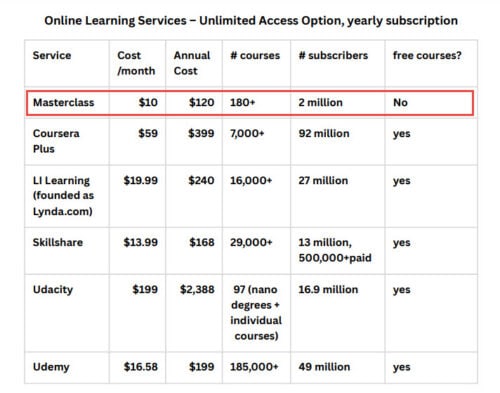
There is a difference between having a competitive price and competing on price.
The former means your price is within the range of what your industry offers. It removes price as a differentiator so your prospect considers your brand on other factors.
The latter encourages price cutting and becomes a race to the bottom. Once you lower your price, your competitors may follow. Then what is your choice? Lower it again?
Competing on price destroys brands, especially premium ones.
Masterclass offers a premium product. Professionally produced, entertaining classes taught by recognizable experts and celebrities.
They have been challenged all along to get users who are attracted for one class to stay and take others. (This may have been behind removing the $90 one class option in 2018.)
Dropping your price doesn’t address that challenge.
Increasing your value in the eyes of your subscribers and conveying that value well do.
To do that, you need to understand your audience, their wants, and how your brand fulfills them.
A New Yorker article in October 2021 reported that Masterclass had an unusually high renewal rate of 52 percent after one year. The typical student watches 10 classes, hopping from subject to subject.
But, the article stated, the time subscribers spend watching classes does not relate to their likelihood to renew.
Masterclass doesn’t know why their subscribers renew.
In the article, Masterclass’s chief product officer says of his efforts to understand and guide subscriber behavior, “Asking them why they like a class doesn’t give you very reliable data.”
This tells me that while Masterclass may have done lots of research to get class feedback, they don’t yet know the segments of their audience well enough to know what attracts them and what makes them stay.
It is true that people have a hard time relaying why they do what they do. That’s where consumer insights gathering techniques shine, and how I’ve helped my clients.
Unearthing customers’ motivations requires creativity. You must ask the right questions to get the answers you want, and often they are not direct or obvious questions.
The only way Masterclass will surmount their brand adolescence and get into the black is to get clarity on their customer segments, understand their motivations, and craft messages and services that resonate with them.
I only managed to complete one full class before my 14-day trial ran out.
David Sedaris’ course on Storytelling and Humor gave me several tips I’ll use in the future.
His approach also made me feel good about my own. We’re both students of the world, observing often, jotting down experiences, and asking good questions.
I did not subscribe, however.
Masterclass is known as the Netflix of online learning. A binge-worthy distraction is not what I need right now!
Have you ever taken a Masterclass?
***
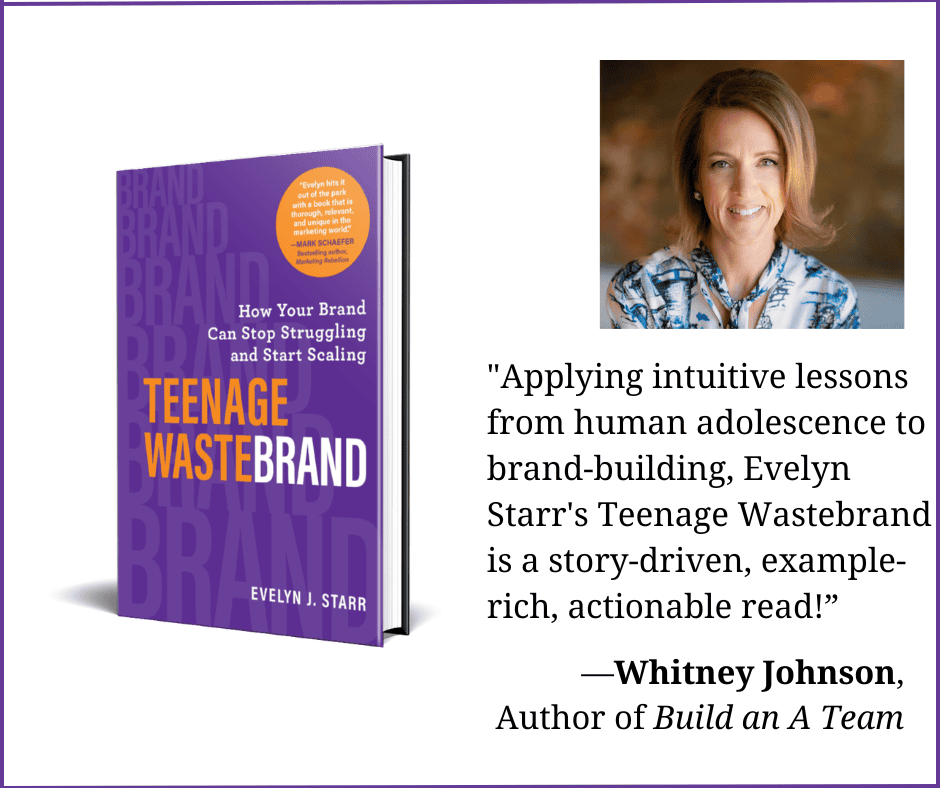
If you and someone you care about has a brand struggling to grow, pick up a copy of my book, Teenage Wastebrand: How Your Brand Can Stop Struggling and Start Scaling.
Or grab the audiobook here. I narrated it myself!
***
Masterclass’s ubiquity on social media platforms during the pandemic made it ripe for parody.
Andy Rowell Teaches Pooping (1 minute, 44 seconds)
Steve Emerson’s Masterclass on Daddy’s Money (2 minutes, 12 seconds)
And of course SNL delivered a Masterclass Quarantine Edition (2 minutes, 43 seconds), and another Masterclass Quarantine Edition (2 minutes, 58 seconds).
Enjoy!
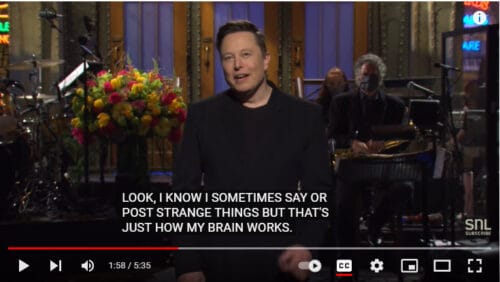
The closest I’ve come to liking Elon Musk was during his SNL opening monologue on May 8, 2021.
But it was never that close.
I admired his courage to appear on the show and willingness to mock himself. His performance humanized him. He was funny in some skits.
Yet my gut told me not to trust anything he said.
Too many shoot-from-the-hip statements and impulsive acts.
One of Musk’s impulsive acts was offering to buy Twitter for $44 billion in April 2022. Twitter’s board accepted his offer. He tried for months to get out of it and haggle the price down.
Advised a court would force him to honor the agreement, he changed tunes and completed the purchase.
New leaders often assess a brand by talking to employees and customers before taking action.
Musk’s due diligence during the purchase process and management style led him to act first, think later.
On October 27, 2022, Musk’s first day as owner, he fired Twitter’s CEO Parag Agrawal and three other senior leaders, making himself CEO.
A week later, Musk laid off 3,700 employees, about half the workforce. Many employees learned of their layoff by discovering they could no longer access their company email accounts.
Just days later, company leaders were asked to compile lists of employees they would ask back, with an emphasis on media engineering. Few wanted to return.
Subsequent layoffs have whittled Twitter to 1,500 employees.
On October 30, 2022, The Verge announced Twitter was raising the monthly price of Twitter Blue from $5 to $20 and requiring verified users to subscribe or lose their coveted blue check marks.
Twitter Blue subscriptions offered top articles, custom icons, and the ability to edit tweets.
Blue check marks signaled the user had passed a stringent verification process. You could trust it was really them tweeting.
After Stephen King balked, Musk dialed the cost down to $8 on November 1.
Musk then offered anyone willing to subscribe a blue verification check mark if they provided their phone number.
A deluge of impersonators and scam artists signed up. Twitter had to halt subscriptions to regain control.
Now with little real value, many celebrities declined to subscribe to preserve their blue verified-user check mark.
In April 2023 when Twitter began enforcing the subscription requirement, Musk decided to comp subscriptions for Stephen King, LeBron James, William Shatner, and Iced T.
Every other nonsubscriber’s blue check mark vanished.
On November 18, 2022, Musk ran a poll on reinstating Donald Trump’s account. It had been banned following the January 6, 2021 attack on the Capitol. Voters narrowly agreed 51.8% to 48.2%.
Twitter restored Trump’s account on November 20, 2022.
Musk’s November 23 poll asked if Twitter should offer a general amnesty to suspended accounts. Seventy-two percent (72.4%) of the 3.2 million users who voted said yes.
Twitter began reinstating suspended accounts the following week.
On December 15, 2022, Musk, a self-described “free speech absolutist,” banned journalists Donie O’Sullivan (CNN), Ryan Mac (The New York Times), and Drew Harwell (The Washington Post) from Twitter, and other journalists who had covered his actions aggressively.
He claimed they “doxxed” him, sharing his exact location in real-time, endangering his family. No proof emerged.
After an uproar, Musk polled Twitter that same day about unsuspending the accounts. Fifty-eight percent voted for immediate unsuspension.
Twitter made the suspended journalists’ accounts viewable on December 17, but required them to remove the “offending” tweets before allowing them to tweet.
Most surprisingly, Musk’s December 18, 2022 poll asked if he should step down as CEO. Fifty-seven percent (57.5%) of the 17.5 million voters said yes.
Musk’s initial reaction was to reconsider who gets to vote in Twitter polls. After a user suggested only blue check mark holders should get to vote, Musk responded, “Good point. Twitter will make that change.”
That did not happen, however.
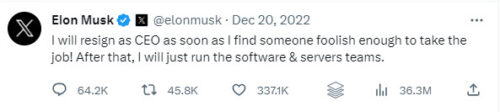
On December 20 Musk said he’d step down after he found a replacement.
But he began undermining his successor by saying he needed to find “someone foolish enough to take the job.”
Brands exist in consumers’ minds as the sum of their experiences.
Twitter came into being as a place to get and share breaking news. It grew into a place for influencers and followers to meet and converse.
Musk’s impulsive management, policy changes, and reversions gave users and advertisers whiplash.
Twitter and Musk delivered tons of bad experiences that eroded trust in the Twitter brand, degraded it, and prompted many users to flee.
Only 43 percent of Twitter’s top 1000 advertisers in September 2022 were still advertising there in April 2023.
For many, the Twitter brand evolved to be more about Musk and his whims than anything else.
Making good on his promise to step down, Musk hired Linda Yaccarino, NBCUniversal’s head of advertising, as Twitter’s new CEO, beginning June 5, 2023.
This pivotal moment could have saved Twitter.
If Yaccarino had shown she would address users’ concerns, restore lost functionality, and stabilize the brand, Twitter users and advertisers might have exhaled and renewed their faith in the platform.
But Musk continued to speak and act for Twitter, undermining Yaccarino.
On July 15, 2023 Musk said advertising revenues were down 50 percent and cash flow was negative.
Though CEO Yaccarino said the company was “close to break even” on August 10, 2023, onlookers remained skeptical. Musk’s July statement makes this financial recovery questionable.
On July 23, 2023 Musk announced he was rebranding Twitter as X. He tweeted a request for proposed logos, chose one, and implemented it the next day.
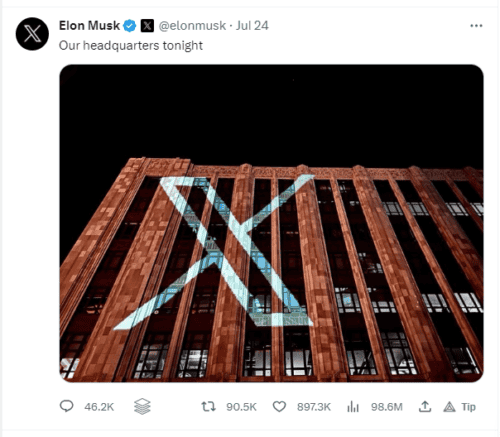
Musk envisions X as an “everything app,” enabling users to make payments, get news, and order food, among other things.
X CEO Yaccarino tweeted about the new brand but it appears Musk is still leading it.
Some long-time Twitter users and influencers with substantial followings are hanging on.
The value they derive from X still outweighs the uncertainty, reduced visibility, and decrease in functionality.
But their patience won’t last forever. It’s waning for some already.
Ann Handley (@MarketingProfs, 453,900 followers) told me, “…I've been spending less time [on Twitter] in the months leading up to the rebrand...But I will say that I have been enjoying [X’s new competitor] Threads.”

Mark Schaefer (@MarkWSchaefer, 167,700 followers), author of The Tao of Twitter, said: “I've learned to navigate Twitter, er ... X, in a way where I experience minimal dysfunction. Follow the good people, block the haters, rinse and repeat. I observe and comment lightly. Not too much discourse these days.”

Arvid Kahl, (@ArvidKahl, 120,300 followers), creator of Find Your Following, a Twitter blueprint, said: “It frustrates me that a platform like Twitter that lives and breathes by the work of the people who use it can be intentionally and violently devalued by leadership like this.
“There are many things Musk could have focused on. Rebranding a beloved name wasn't one of them. I still love the community on there. Just not the fact that it is now X.”

Julie Van Ameyde, (@SimplySocialMI, 1,057 followers) owner of Simply Social Media, LLC, said: “For me, the most significant difference is the ability to monitor Twitter for clients on Agorapulse…I am now back to manually monitoring 15 Twitter accounts and their brand mentions/keywords, causing me to waste the time I need.
I also find it interesting that many automotive OEMs abandoned Twitter/X almost overnight when the Musk transaction was complete.”

Dhariana Lozano, (@DhariLo, 22,900 followers) Social Media Consultant and Speaker, told me: “I'm not the happiest about it [changes to Twitter/X]…My biggest concern is…it seems to be heading in a very ‘pay to play’ direction and I don't like that.”
Musk has made it harder for these influencers to enjoy the X platform and use it efficiently. That’s a recipe for contracting a brand, not expanding it.
From a strict renaming point-of-view, Twitter’s rebrand to X is at best premature.
Rebrands signal major changes. Musk intends those. But his changes remain aspirations.
Musk has tossed Twitter’s towering brand equity in favor of his beloved X with no strategic gravitas to show for it.
Meanwhile the platform’s real problem is eroding trust.
The name change seems to have expedited the erosion. I ran a poll on LinkedIn asking Twitter users how the rebrand to X affected their trust of the brand.
Of the 50 Twitter users who responded, 26 said they trust X less than Twitter, and 10 said they had left Twitter.
Though not statistically significant, the results flash like the early evening iceberg warnings the Titanic ignored.
To turn this ship, X needs:
To tame Musk. His impulsive acts drained his credibility, and took Twitter down with him. Though he installed Linda Yaccarino as CEO to help win advertisers back, his prominent voice continues to undermine her and the X brand.
To build on Twitter’s essence. Twitter began and grew as the place to get live news. While X may not be able to lure defectors back, keeping users who loved Twitter would be easier if they still felt that lure.
This means taking steps to ensure news is easy to find and reliable.
To talk to users and address their concerns. Management must understand users’ and advertisers’ concerns and address them to demonstrate they care. Policies and features need to encourage use of the app, not make it harder or waste users’ time.
To take cues from users. No one switched to x’s instead of tweets. Users are still saying tweets, and that term differentiates the X platform from other social media. Go with that!
To be transparent. Though Musk’s purchase makes the company private, advertisers and influencers don’t want to invest in a brand with a questionable future. Transparency about usage, finances, and issues they are addressing is the only way to restore credibility.
To rebuild trust. X may aspire to be an “everything app,” but why would someone who doesn’t trust the platform for social media use provide personal payment information? They won’t.
Before expanding, X needs to regain the trust from key constituencies and get people to want to spend time on their app.
It’s a tall order. Do you think X can succeed?
***
Don’t let your brand make Twitter’s mistakes. Hear about good brand practices as Matt Lyles and I chat about them on his SIMPLE brand podcast. We discuss:
Listen (36 minutes, 58 seconds) and get show notes here.

Watch Elon Musk’s SNL monologue. (5 minutes, 36 seconds)
As a mother of two young children in the early 2000s who worked from a home office, occasionally I would need a break.
A few hours out of the house on my own to remember who I was without any obligation to feed, clothe, wash, educate, entertain, or otherwise support someone else.
When possible, I’d go while the kids were at school. Most often my husband would take care of the kids for a few weekend hours so I could wander, shop, or just be.
During that me-time, I often found myself gravitating to a cavernous Barnes & Noble store in Framingham, Massachusetts.
I meandered the aisles. New Best Sellers! Staff Picks! Travel! Biographies! Historical Fiction! I picked up books or magazines that looked interesting, and nestled into one of their oversized armchairs to read.
Being among all those books buoyed my soul. My book and journal purchases were gifts to myself.
Somewhere around 2009, the store began to lose its allure.
First the toy section swallowed most of the front of the store.
Then the toys were displaced by two massive Nook e-reader kiosks. To get to the books you had to navigate around them.
I no longer exhaled in book zen upon entering nor felt the joy of discovering a book I wanted to read.
It made me sad.
Barnes & Noble went public in 1993 and launched their superstore concept. Their strategy involved besting competitors with their immense inventory and steep book discounts.
The strategy fueled the brand’s growth, from 520 superstores in 1999 to 726 in 2008.
More than 1,000 book shops closed between 2000 and 2008, though independent bookstores did not vanish.
And before long, the independents and Barnes & Noble shared a common enemy: Amazon.
In 1998, Amazon was 4 years old, and not yet profitable. Barnes & Noble did not see Amazon as a serious threat.
But Amazon proved better at the volume-and-discount strategy than Barnes & Noble were.
The Great Recession and Amazon’s rise forced a reckoning.
Borders bookstore chain succumbed in 2011, filing for bankruptcy and leaving Barnes & Noble as the sole brick-and-mortar counterweight to Amazon’s onslaught.
Barnes & Noble’s leadership made the mistake of trying to compete with Amazon where Amazon had decided advantages.
They launched the e-reader Nook in 2009 to compete with Amazon’s Kindle which came out in 2007.
They redid their website to stoke online sales.
A good website and an e-reader would be good for the brand, but these were catch-up moves required to compete in the industry, not pivotal forces that would turn the brand’s fortunes.
Barnes & Noble added toys, games, and other non-book related merchandise to stores.
They even tried opening restaurants adjacent to the stores to drive traffic.
To no avail.
Barnes & Noble began closing stores in 2010 and were down to 627 by 2019. Five CEOs cycled in and out between 2013 and 2018.
In 2018 the company lost $18 million and fired 1,800 full-time employees.
In 2019, the hedge fund Elliot Advisors acquired Barnes & Noble for $683 million. Elliot had purchased the British bookstore chain Waterstones the year before.
Waterstones’ CEO James Daunt had rescued that brand years earlier.
Daunt was a bookseller himself, having opened his own independent store in London in 2005, specializing in books for travelers. Daunt Books is still in business and has six stores.
Elliot named Daunt Barnes & Noble CEO as well. Daunt relocated to New York and got to work.
Daunt’s audit of Barnes & Noble yielded his assessment that the stores were “crucifyingly boring.”
In a 2020 keynote address to the Book Industry Study Group, Daunt said bookstores justify themselves in the age of Amazon:
“by being places in which you discover books with an enjoyment, with a pleasure, with a serendipity that is simply impossible to replicate online. And to do that, you have to have a good bookstore.”
For Barnes & Noble, Daunt sought to “create an environment that’s intellectually satisfying—and not in a snobbish way, but in the sense of feeding your mind.”
I felt seen when I read that.
Six months into Daunt’s tenure, the pandemic struck. All 600 Barnes & Noble stores had to close. Instead of panicking, Daunt initiated a transformation.
Stores were redesigned and refreshed.
Daunt asked employees to scrutinize each book in their store and decide if it belonged there.
He decentralized book buying and empowered local store managers to craft their offering mix. He encouraged managers to curate selections based on their interests.
More shocking, Daunt ceased taking publishers’ promotional money. This amounted to millions of dollars, but obligated stores to push publishers’ favored books via displays and discounts instead of promoting what interested customers.
Daunt’s approach is working.
Sales in 2021 exceeded pre-pandemic levels and have continued to grow. Barnes & Noble opened 16 new stores in 2022, and expects to open 30 in 2023. Some new stores occupy locations where Amazon’s brick-and-mortar bookstores failed.
As I read several excellent articles on Barnes & Noble’s turnaround, I noticed writers dancing around the edge of the reason for Daunt’s success, but missing the bullseye.
Ezra Klein in The New York Times chalked Daunt’s success up to his focus on empowering local store managers.
Elizabeth Segran in Fast Company credited Daunt’s encouraging local managers to curate selection based on their own tastes as the definitive factor.
Ted Gioia got closest, saying “the key element uniting all of this is putting books and readers first, and everything else second.” He said the lesson here was if you want to sell books, you have to love them.
Loving books helps, but that isn’t the reason Daunt’s approach is working.
The real reason is common sense marketing: He focused on the target audience.
To do that, he had to know them.
He knew book buyers:
Daunt also understood:
It was not Daunt’s love of books driving Barnes & Noble’s turnaround. It was his courage to prioritize and protect the target audience, readers.
I suspect Daunt knows most bookstore managers and employees are also readers, making them part of the target audience. Their passion for books motivates them to work there.
You knew that too, right? If not, go rewatch You’ve Got Mail.
If your brand is struggling or underperforming, pull from Daunt’s playbook.
Focus on your ideal customers. Daunt isn’t refashioning Barnes & Noble for the guy who needs a technical manual on how to wire your house and makes a one-time buy from Amazon. He’s building around book-buying enthusiasts.
Understand your ideal customers. Daunt loved books and was already a bookseller in touch with his market.
You don’t have to be a prime user of the product your brand sells, but you need to know who your ideal customers are and what they seek. Lego CEO Jørgen Vig Knudstorp consulted both child and adult Lego enthusiasts as he turned the company around in 2005 and kept in touch to fuel the brand’s growth.
Ditch the old customer segmentation framework of starting with demographics.
Seek deep understanding of customers’ mindset, the needs and problems they have, the experience they seek, and the emotions that accompany that experience.
Localize your marketing. Daunt knew that each bookstore’s community differs in profile and tastes, even within the same city, and enabled managers to cater to their specific market.
When you tailor your offerings to the local community, they feel recognized and understood, and respond with their business.
Engage employees. Daunt empowered managers and employees because he recognized them as Barnes & Noble’s face to customers. Their direct contact positioned them to know their customers best.
Your sales people, account managers, customer service representatives – any brand team member who interacts with your audience – are the face of your brand.
Tap their knowledge. Empower them. Motivate them. Customers’ experiences with them become your brand in their mind.
Deliver a unique experience. Emphasize what you can deliver that your competitors can’t.
Barnes & Noble’s customers come for the experience of exploring and lingering, finding books that interest them, and consulting employees they get to know.
Amazon can’t deliver any of that.
Resist bad influences. Forget Jerry Maguire. If someone shows you the money, but requires actions that are off-brand or inconsistent with delivering your best customer experience, pass.
Daunt’s prioritizing customer preferences over publishers demand-laden cash offers was another way he helped Barnes & Noble say to their audience we get you.
You don’t have to love the product your brand sells to be an effective CEO. You have to focus on your key customers, serve them, and protect their interests.
Barnes & Noble closed their Framingham store in January, but are opening a new one in my town this spring. I’m looking forward to checking it out!
Do you have any book recommendations?
Where do you go for me-time?
How does your brand demonstrate your understanding of your customers?
Please let me know in the comments below.
***
I may have had a little too much fun searching SNL for related skits.
See how hands-off Amazon’s retail service got. (2 minutes, 30 seconds)
Watch Looks at Books author interview with original cast members Gilda Radner and Jane Curtin. (2 minutes, 53 seconds)
Visit The Scorched Corset bookstore. (4 minutes, 6 seconds)
Hear RuPaul’s different definition of reading at The Library. (5 minutes, 20 seconds)
Enjoy!
For decades M&M’s conjured memories of focus groups for me.
During my years in consumer insights departments (aka marketing research) for Veryfine Products and Dunkin’, I sat behind the mirror watching customers react to new product ideas, ad campaigns, and new store designs.
To welcome clients, focus group facilities stocked the back rooms with an array of soft drinks and snacks.
A bowl of M&M’s was de rigueur. Sometimes multiple bowls, both plain and peanut flavors.
It’s easy to lose track of how many you nibble during a two-hour session.
But your scale knows.
I quickly learned to stake out my seat and move those bowls as far away as possible.
I hadn’t given M&M’s much thought until my friend Mark Schaefer asked me to provide a brand perspective on their recent hullabaloo in an interview for his online community.
After watching M&M’s marquee 2023 Superbowl commercial, my friends Dominic and David insisted I write about the trainwreck.
Who am I to deny a request?
Okay folks, as Maria sings in The Sound of Music, let’s start at the very beginning.
M&M’s launched in 1941 as military rations. Their hard candy shell enabled soldiers to carry chocolate in warm weather.
Ask anyone over age 40 about M&M’s and we’ll tell you they “melt in your mouth, not in your hand.”
M&M’s adopted that tagline in 1954, likely inspired by the military purpose. Commercials showed mothers happier with M&M’s because they did not cause the mess of other chocolate candies.
Were civilians worried about messy chocolates? Who knows?
The tagline’s claim became both brand differentiator and purpose.
M&M’s introduced their spokescandies, red and yellow cartoon characters, in 1960.
By 1999, there were 5 computer-generated figures: red, yellow, orange, blue, and green. Each had a distinct personality.
Red was bossy.
Yellow was a peanut M&M and portrayed as dim-witted.
Orange was anxious.
Blue was confident.
Green was the only female in the group. She was a diva, depicted as “sexy,” and sported go-go boots.
The last use of the tagline I can find is this 1997 ad with the spokescandies as guests on Dennis Miller’s talk show.
Forty-three years with one tagline. Impressive.
In 1998, M&M’s marketing team must have decided people no longer worried about chocolate melting in their hands.
Just like that, the tagline melted away, taking the product’s differentiation and purpose with it.
A close look at M&M’s ad campaigns over the next 20 years shows a brand having an identity crisis.
1998: “Official candy of the new millennium.” MM are the roman numerals for 2000. Get it?
2001: “What is it about the green ones?”
2002: Contest to choose a new color to add to M&M’s bags – purple won.
2004: “Chocolate is better in color.”
2007: “There’s an m in everyone.”
2011: “Can’t resist m.”
2012: Ms. Brown introduced during Superbowl 2012 as “Not your average chocolate.” Ms. Brown was confident, strode in stilettos, and wore smart eyeglass frames.
2017: Clean energy promotion
2018: “Always fun.”
As I mention in my book, Teenage Wastebrand, brand identity is a combination of purpose and attributes.
On January 21, 2022, M&M’s announced their mission (aka purpose) “M&M’S® promises to use the power of fun to include everyone with a goal of increasing the sense of belonging for 10 million people around the world by 2025.”
This new purpose set them up with two obvious brand attributes: fun and inclusive.
M&M’s implemented several initiatives:
M&M’s also tweaked some spokescandies in January 2022, seemingly in support of their mission.
Red became nicer.
Orange embraced his true self, worries and all.
Ms. Brown lost the Ms. and traded her stilettos for pumps.
Green swapped her go-go boots for sneakers.
Changes to the female characters, Brown and Green, caught conservative commentator Tucker Carlson’s ire.
"M&M's will not be satisfied until every last cartoon character is deeply unappealing and totally androgynous," Carlson said. "Until the moment when you wouldn't want to have a drink with any one of them. That's the goal. When you're totally turned off, we've achieved equity. They've won."
In September 2022, M&M’s introduced Purple spokescandy, a female, peanut M&M designed “to represent acceptance and inclusivity.”
When a limited-edition pack came out in January 2023 featuring only the female characters and supporting “women out to flip the status quo,” Carlson chimed in again.
He called Purple “an obese and distinctively frumpy M&M” and chided Orange for “becoming a poster boy for the mental-health crisis.”
It’s no mistake that the mission announcement and the limited-edition women’s initiative pack both came in January.
M&M’s are a long-time Superbowl advertiser. Generating buzz around the brand prior to the game helps them get publicity and more mileage from their Superbowl ad spend.
Both the spokescandy changes and Carlson’s outbursts stoked the PR fire. Hundreds of media covered the controversy, including CNN, Vox, Fortune, Forbes, The New York Times, The Washington Post, and The Guardian.
M&Ms kept mum to the hoopla in 2022.
On January 23, 2023, after Carlson’s second outburst, M&M’s announced the spokescandies were taking “an indefinite pause” and SNL alum Maya Rudolph would replace them as spokesperson.
A message from M&M'S. pic.twitter.com/EMucEBTd9o
— M&M’S (@mmschocolate) January 23, 2023
Tucker Carlson declared victory. Pundits and commentators hypothesized why they would do this.
Five days later, the indefinite pause proved to be a publicity stunt. M&M’s assured the world the spokescandies would be back with an ad during the Superbowl.
The public was primed for a major M&M’s statement on inclusion or at least an entertaining commercial. They received a lame mock ad for clam-flavored M&M’s.
The spokescandies addressed their return in an ad that ran AFTER the Superbowl game was over. Three spoke, but said nothing about inclusion.
While it is true that a brand identity sets direction for marketing communications like advertising, it does more than that.
A brand’s purpose serves as a North Star for the entire organization. It determines strategy and initiatives, guides employees in decision-making, and shapes company culture.
Employees want to work for a brand with a purpose they believe in.
But a brand purpose only succeeds if the company embraces it and is willing to defend it.
Otherwise, it’s lip service.
M&M’s used their purpose to fund a few initiatives, create a sensitivity board, tweak their spokescandies, and generate publicity.
When public discourse didn’t go as planned, the company recoiled and used the moment for another publicity stunt.
Their commercials seemed to say don’t take us seriously.
Two days after the Superbowl, M&M’s announced they were celebrating the official return of the spokescandies by doubling the number of $10,000 grants offered to “change-making women” from 10 to 20, “putting the ‘fun’ in funding their initiatives while increasing the opportunity for trailblazing women to champion a positive impact on society.”
M&M’s PR team generated lots of free press coverage, but the brand has taken a big hit on their credibility.
Their actions have left me wondering:
I’m betting many M&M’s customers are wondering too. M&M’s may be repelling people more than making them feel included.
If M&M’s believe they are uniquely poised to use fun to promote inclusivity, then they should lean into it, not shy away when controversy hits.
Begin in house. The first people M&M’s should make feel included are their employees. They need to feel the fun and inclusion before they can help the brand demonstrate that to the world. If M&M’s culture isn’t fun and inclusive, no campaign can convince the world the brand is.
Stand up for your beliefs. View Tucker Carlson’s commentary as more than just publicity. It’s challenging the brand’s identity. Bark back.
Let your identity guide you. If you are fun and inclusive, those attributes should guide your message and voice as you support and defend your purpose.
Demand your creative team meet the challenge. Ask your agency to craft a response, not a retreat. Red used to be bossy and is now nicer. Maybe he could address the situation via what he has learned about kindness and inclusivity, in a fun manner of course.
Involve Maya Rudolph. A casualty of M&M’s publicity seeking is their underutilization of the veteran comedian. Not only is she a fun, fabulous talent with the right demeanor to help M&M’s mission, but she is also Black and Jewish, embodying the brand’s attributes.
Accept that not everyone will agree. This is where many brands struggle. To have a purpose means to stand for something. Not everyone will agree. It’s ironic, but standing for inclusion may deter some people.
Using fun to promote inclusivity is a great idea. I hope M&M’s can implement it beyond publicity stunts and donations, and not melt when challenged.
What was your reaction to M&M’s marketing hullaballoo?
***
Check out this much better Superbowl commercial from 2021 – already on the fun and inclusive trail a year before they announced their new mission.
Some brides get superstitious before their wedding. Luckily that’s not me.
Dan and I got married in June 1994. On the Friday that kicked off our wedding weekend, the US began hosting World Cup Soccer for the first time.
At the opening ceremonies in Chicago, host Oprah Winfrey fell off the stage. Diana Ross pulled a penalty kick left, but the goal posts had been rigged for drama and split open anyway.
Those weren’t even the weirdest events that day.
They were eclipsed that evening by OJ Simpson as he led the LA police on a low-speed highway chase in a white Ford Bronco. Thirty-five miles per hour and yet the chase went on for 60 miles.
Despite these oddities, our wedding went smoothly that Sunday. On Monday we left for a two-week honeymoon in Greece.
And when we returned, Federal Express as we knew it was gone.
Every company truck, plane, package, and envelope from the former Federal Express now said FedEx.

It was weird, but easy to understand. The verb “to fedex” had been in our business lexicon for a few years by then.
What a quick transformation the company pulled off. They timed it to happen overnight on June 24, 1994.
You can imagine the amount of money, time, and effort they spent to orchestrate that.

Why would they do that though? The company was growing and business was good.
When Fred Smith launched Federal Express in 1973, nationwide overnight delivery seemed like a pipedream. The concept was so farfetched that Xerox shipped empty boxes for two weeks before entrusting them with document-filled ones.
The initial job of the Federal Express brand was to represent speed and reliability. Hence the tagline “When it absolutely, positively has to be there overnight.”
Creative approaches to emphasizing their speed resulted in entertaining commercials starring fast talker John Moschitta.
People frustrated with the United States Postal Service (USPS) – the only other option at the time – began to give them a try.
By the early 1990s, with their reliability and speed established, Federal Express was going global.
Meanwhile, competitor Emery had copied Federal Express’ model by getting their own planes.
Airborne Express entered the small package air express business.
The USPS began pushing their own overnight delivery service.
United Parcel Service (UPS), the largest shipper via trucks, entered the air shipping business. DHL Worldwide Courier Express Network replicated Federal Express’ US model overseas.
Though business was still growing, Federal Express found itself as a brand in adolescence with lots of competition.
American high schools offer teenagers the opportunity to compete in sports by fielding their best athletes on a team they designate as Varsity.
High schools often combine students from several different areas of a city or town. Many students who played a sport in elementary and middle school find themselves vying for the few spots on the high school varsity team.
Brands in adolescence can face similar competition.
When Federal Express began, they were the only overnight option. As their success grew, competitors flooded in.
Like teenagers trying to impress a coach for a spot on the varsity team, Federal Express now tried to stand out in a crowded field for their customers’ consideration.
I call this brand adolescence symptom defending your varsity team spot.
Federal Express’s overnight transformation to FedEx turned out to be the culmination of two years of research and rebranding work.
Both the name change and the logistics feat reminded customers and the public that they personified speed and reliability.
But FedEx did not stop there.
In their research, FedEx no doubt heard that even with their brand promise, customers were anxious about packages arriving on time while they were in transit.
FedEx looked for ways to deepen their relationship with customers by allaying their anxiety.
They built a proprietary tracking system so customers could not only have faith that the brand would deliver on time, they could get proof of where their package was in the process.
Their tracking option proved highly desirable among customers and differentiated them from rivals.
FedEx also created the first automated package shipping system for PCs and, in the mid-1990s, was one of the first companies to enable business-to-business transactions on its website.
Noting their customers’ international business dealings, FedEx expanded overseas, becoming authorized to serve China in 1995. Through an acquisition from Evergreen International Airlines, they became the sole US cargo-only carrier with aviation rights to China.
In February 2004, FedEx bought privately-held Kinko’s (a document-copying and business-services store chain) and branded them FedEx Kinko’s (and, in 2008, FedEx Office), giving the brand 1,200 outposts to expand their reach to customers and make it more convenient.
FedEx maintains their lead in the overnight shipping industry by constantly looking for ways to enhance their customers’ experience.
How do know if you need to defend your brand’s varsity team spot?
Here are some telltale signs:
1. Your marketplace has become crowded.
If your brand launched into a “white space” – a gap in the marketplace where customers’ needs were not met – your success may have attracted many competitors.
While Federal Express founded the overnight delivery industry, they had plenty of competitors offering the same service twenty years later.
2. Your purpose no longer differentiates your company.
Overnight delivery was a unique – and outlandish – purpose initially. By 1994, it no longer distinguished Federal Express from its competitors.
FedEx broadened its purpose to include logistics to set themselves apart, and announced that by flipping the switch on their rebrand.
Spotify initially focused on allowing listeners to stream music legally. Once that space became crowded, Spotify CEO Daniel Ek revised their purpose to focus on supporting creativity and acknowledge both their user and artist audiences.
3. Your brand attributes have become category attributes.
Speed, reliability, and overnight set Federal Express apart in its early years. Now all players in the industry must have those to compete.
FedEx’s rebrand and continued evolution have added logistical expertise, peace of mind, and convenience to distinguish them from the pack.
If your brand’s dominance in your niche has eroded, you’ll need some strategic work to reassert your market leadership.
Clarify your brand identity and evolve if needed. Has your purpose become commonplace, like Federal Express’s overnight pledge had?
Have your brand attributes become category attributes like speed and reliability did for Federal Express, no longer differentiating them?
Conduct research among your audiences (customers, partners, employees) to rediscover why they come to you and what current needs remain unmet.
See where you can serve them in new and unique ways. Revise or update your purpose and attributes if needed.
Deepen your brand’s relationship with your audience by doubling down on your niche. Through research and conversations with your audience, continue to build your knowledge about them and seek to understand them more than your competitors.
Use your knowledge to serve your customers better than your competitors. FedEx discovered their customers were still anxious about their packages in transit, which led to their tracking system creation.
Address not only the functional needs of your audience but the emotional ones too. The peace of mind FedEx’s customers felt when they were able to see exactly where their package was catapulted the company back to the go-to shipping choice.
For more on how to defend your brand’s varsity team spot, check out Teenage Wastebrand: How Your Brand Can Stop Struggling and Start Scaling (Chapter 8).
By initiating the overnight shipping industry, Federal Express had the market to themselves for a while. But success attracts competitors, and the honeymoon ended.
It is worth noting FedEx’s 1994 rebrand was not just cosmetic but reflected real strategic changes in the company. Companies that just change their logo and don’t revitalize their brands don’t boost business.
FedEx has worked hard to maintain their market leadership and capitalize on their OG shipping stature. (OG is original gangster, for those old enough to have used FedEx in their early years.)
These days Amazon is among their toughest competition. Once the new-niche honeymoon ends, it rarely comes back.
Happily, my honeymoon continues…going on 28 years this June!
***
The wedding industry is booming now, as many who postponed their wedding early in the pandemic are getting married this year. Resources for the big day can be hard to find.
If you have a need to officiate a wedding for a friend or family member, Miller Lite and the Universal Life Church would like to help. See how to get ordained here.
Hat tip to Rohit Bhargava for noting this in his Non-Obvious Insights Newsletter.
Likewise, many people who postponed vacations have trips planned now.
Check out this SNL insightful commercial about what vacations can and cannot do for you.
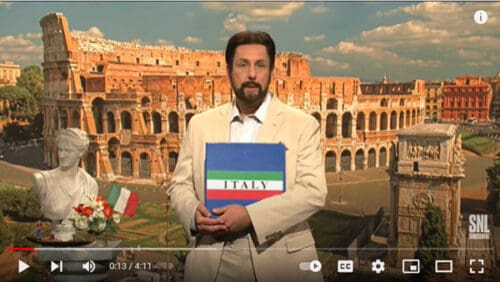
Thanks to Austin Kleon for tweeting about this.
This post is an updated and enhanced version of one published November 14, 2014.
Have you heard a December holiday song yet?
It always amazes me how early the holiday music starts. I am among the 81 percent of Americans who don’t want to hear it in stores before Thanksgiving.
But while I am not ready to endure endless loops of “Grandma Got Run Over by a Reindeer,” I am already thinking about my business holiday cards.
In fact, I confess, I ordered them November 1st.
Why do I look forward to this ritual that many people find stressful?
Two reasons. First, I love handwriting cards and making a personal connection that way.
Second, I do them by choice, not from a sense of obligation.
For most people though, business holiday cards present a conundrum.
To send or not to send? Paper or e-card? Clients only? Or should you include employees, vendors, referral sources and prospects? How will someone feel if you don’t send them a card?
And the biggest question of them all: is it worth the effort?
Business holiday cards are one drop in the relationship marketing bucket.
The answer to “is it worth it?” is the same as all your other marketing efforts: only if it furthers the relationship.
Here are my holiday card guidelines to help you decide if you should send them, and to increase your success if you do.
The inspiration for this article came from a rant my husband sent me. He received several e-cards that turned out to be 1 – 1 ½ minute-long videos he characterized as “a completed waste of my time.”
He also said, “[With a traditional card] I know my contact put in the thought of signing their name and making it at least a scintilla personal. I will display cards in my office for a few weeks. The video? Gone as soon as I forward it to you.”
The companies that took the time to make the videos and send the email link actually hurt their relationship with him by annoying him. They would have been better off sending nothing at all.
Companies don’t celebrate holidays. People do. A holiday greeting should be from sender to recipient. Recipients see right through efforts to delegate the greeting. If you can’t sign the cards yourself, don’t send them.
This does not mean you have to spend hours thinking up what to say.
Find a short, meaningful phrase you can use for everyone (like “wishing you a happy and prosperous year!”), then add something else only if you want to. That phrase and your signature will be enough.
Like the rest of your business communications. This helps your cards remain inclusive and keeps the focus on your relationship.
The presence of a business card casts a marketing-pitch-pall over the greeting and loses the sentiment.
I aim to get my New Year’s cards to recipients in first week of the New Year.
Many people have thanked me for the cards. No one has ever chided me for not getting them there before New Year’s (and many people aren’t in the office that week anyway).
Over time you will add and delete names from the list and that’s okay.
You can always choose another holiday. And a handwritten card on a non-holiday is always welcome!
Remember that your goal is to further your relationship with the recipient. It’s better to send 50 personalized snail mail cards than 5000 meaningless and forgettable e-cards.
Fifty? Did she say 50? OMG. [Heart palpitations.]
Okay, step back from the email.
Take a few deep breaths. Come back once your regular pulse returns.
Sending handwritten cards can actually improve your health, especially if you are expressing gratitude.
If you want to send cards but still feel stuck or overwhelmed, I can walk you through.
1. Choose a holiday. Yes, I’m serious. We’re being deliberate about everything. If this time of year is crazy in your business, choose another holiday.
St. Patrick’s Day. Arbor Day. Independence Day. King’s Day (for my Dutch friends). Bastille Day (looking at you, France).
One year our family sent out Groundhog Day cards. Unusual? Weird? Yes.
Did they get noticed and bring smiles? You bet. Especially from the people to whom we sent the same card two days in a row!
Handwritten cards are always welcome.
2. Start with 10 or 20 cards. That’s it. I saw your reaction to 50. We’re not going there.
You can support small businesses, museums, and/or artists and feel doubly good about your effort.
Here are some great places to get business holiday cards for the December holidays. (I receive no compensation from these places.)
If you want help finding cards for a different holiday – or choosing a different holiday – reply to this email and I’ll help you.
3. Choose your recipients. Don’t overthink this. Who do you appreciate in your work? It can be a mix of customers/vendors/partners/co-workers.
Sending to employees is an excellent idea too.
If you are a boss, sending to some employees and not others could stir resentment, so please consider sending to your entire team if you are going this route.
4. Schedule card-writing time. Really. For this to happen, you need an appointment you will respect. For 10 cards, budget an hour. For 20, two hours.
5. Craft your message. Another place to not overthink. Something short and genuine will do. It could be as short as “Wishing you a fabulous 2022!”
6. Handwrite the cards and address the envelopes. Typed or printed-label addressed envelopes lose the personal aspect, while hand-addressed ones make the open rate soar.
One business owner reported a 99 percent open rate.
My hand-addressed-envelope open rate goes to 100.
Optional: add a sentence or two to your holiday message referencing one small aspect of your relationship.
If you have lunch plans in the new year, that could be “looking forward to our lunch on [date].” Or, “It was great to see you at [name of conference].”
7. Seal and stamp the envelopes. Or have your assistant or child do this. It’s the one thing you can delegate!
8. Mail the cards so that they arrive on time.
9. Reward yourself. A fist pump, a victory dance, your favorite indulgent beverage. Acknowledge your accomplishment!
Please let me know if you get inspired by this post and follow through on your holiday cards. I’ll send you a congratulations card celebrating your effort.
Whether or not you listen to holiday music as you write your cards is up to you. Just don’t play it before Thanksgiving!
Early holiday music isn’t the only autumn irritant related to December festivals.
The North Ridgeville, Ohio police department had to reassure residents they would not be charged for putting up Christmas decorations before Thanksgiving after half-joking it would constitute disorderly conduct in their Halloween Facebook post. (Facebook account necessary for that link.)
Did you know that IMDb displays the user rating for This is Spinal Tap out of 11 stars? (You can catch the original trailer there too.)
Finally, in this video from Studio C, The Hartfords and the Joneses show how not to use holiday cards. (6 minutes, may be a bit traumatic for cat owners)
Every summer I go berry picking at least once.
This year my husband and I picked blueberries on an August Saturday at Tougas Farm in Northborough, Massachusetts.
During the two hours we were in the field, I reveled in the berry-picking crowd.
Entire families picked berries together.
Parents with toddlers chatted with them as they picked, asking questions about what they were seeing. Their banter warmed my heart.
Strangers smiled at each other. Conversed.
No one was on their phone.
No one rushed.
Everyone spent several minutes picking from an individual blueberry bush before moving on.
What a serene and focused atmosphere.
It wasn’t just that it was Saturday or a sunny August day.
People were deliberate and unhurried because berry picking rewards patience.
Blueberries are small. It takes many to fill a quart container.
That can be daunting when you get to the field and see the first photo below.


At first, green leaves dominate your view. Few ripe berries appear initially, perhaps the three circled in red in the picture above.
If you rush, you pick those three and move to the next plant.
If you study the plant, you see several berries in the background, partially obscured by leaves, where the red arrows are in the picture above.
Looking closely multiplies your berry opportunities. If you move the leaves near those red arrows, you find clusters of berries where only a few were visible initially.
And if you stay long enough to move aside leaves where berries were not visible, like in the yellow rectangle section of the picture above?
Look what you could find:

Patience allows you to see what others miss. Rushed pickers don’t push aside inner leaves. They forget to look up or crouch down.
Ironically, rushed pickers spend longer and expend more energy collecting berries than those who take time to explore the plant in front of them.
The tenets of good berry picking apply to developing a niche for your business.
Powers of observation, assessment, patience, and care all come into play.
Like approaching a blueberry bush, it takes time to get insights into a niche market.
Prospects need to know, like, and trust you before they will buy from you. Many won’t reveal themselves until they have observed and assessed your brand.
You need to build relationships with them.
Rushing the sale before your prospect is ready can turn them off. Like an underripe berry carelessly picked, your relationship may never ripen to the point where your prospect becomes a customer.
It takes self-discipline to wait until the right moment to make your offer.
As experienced pickers can return again and again to a few bushes to fill their containers, business owners who invest in developing a niche can find it will sustain their business for years.
Not every business owner has the patience and self-discipline to develop a niche.
Many business owners fear a niche won’t be big enough to support their brand’s growth.
The time niches take to germinate stokes that fear.
But if you can weather the initial years it takes to establish your brand’s niche, it can pay off for decades.
Examples abound.
Founded in 1980, Whole Foods focused on organic food before it was fashionable and operated in Austin, Texas for four years before expanding to the Houston area. When the company went public in 1992, it had 12 stores across four states: Texas, California, Louisiana, and North Carolina.
When Amazon purchased Whole Foods in 2017 for $13.7 billion, the company had 460 stores, presence internationally, and 87,000 employees.
Powell’s Books has focused on selling used and new books in Portland, Oregon for 50 years. Their annual revenue has grown to $111 million and they are a third-generation family-owned company.
Furniture by Penn has provided handcrafted, custom-made furniture made from sustainable materials to customers in Southern Ireland for 48 years.
Vermont Wooden Toys has produced local wood products for 51 years. Despite an outdated website, no social media marketing, and only recently accepting credit cards, orders are still booking four months out.
Kerrygold has sold milk products since 1962. A global Irish brand, Kerrygold hit revenues of €1.3 billion in 2020. Their butter is the top seller in Germany and the number two brand in the U.S. I enjoy their Dubliner cheddar cheese.
Vineyard Vines began their preppy vacation-wear company by selling colorful, irreverent, island-inspired print ties on Martha’s Vineyard in 1998.
They crossed the $1 million sales mark in three years, helped by a $400,000 order from Aflac for ties with their iconic ad campaign duck. Dun & Bradstreet estimates their current sales a $1.5 billion.
A niche is a sustainable business strategy and among the best ways to differentiate your brand. Every brand above is well-known for their niche and a go-to for their target audience.
They became known through years of commitment to their niche.
Do you have the patience to develop your niche?
Take a page from their play book and that of expert berry pickers.
Survey the terrain. Assess your potential niche like an experienced picker would choose a blueberry bush.
How big is the market? Who are the players? What does the target audience seek? Does your brand offer something truly different and desired?
Choose an ample-sized, underserved niche where your offering is unique. Ample means big enough to help your brand grow for at least several years.
Kerrygold’s butter and cheese get their unique flavor from cows’ milk enhanced from the cows’ consumption of Ireland’s rich and sweet grass. That’s hard to replicate.
Look beyond the obvious. Just as you need to get close and move leaves to see the true bounty of a blueberry bush, your niche knowledge gathering requires deep insights.
Talk to customers about the circumstances that prompt them to seek your brand, the ways they use your offerings, the experience they have buying from you. Identify opportunities to serve them better and improve their outcome.
Powell’s launched their website and began selling books online in 1994, a year before Amazon and three years before Barnes & Noble starting selling online.
Demonstrate your commitment. Speak specifically to your ideal customer in your marketing. Show them you understand their challenges, that your brand can deliver their desired outcome. Adapt as your customers’ needs evolve.
Vermont Wood Toys honored their buyers’ desire for all-natural products when they stopped using external stains and sealers in 2015.
Vineyard Vines features their employees and customers on their website as the “Real Good People” part of their “Our Story” page.
Be patient. Build relationships. Get to know your target market by taking a genuine interest in them and connecting with them often. Gain their trust. Focus on serving them long term.
Repeat business is cheaper to gain, more profitable, and more fulfilling than a succession of one-time sales. Like expert blueberry pickers who fill their containers over and over from a few abundant bushes, your patience will be rewarded.
Furniture by Penn aims for this explicitly: “By specialising in lifelong customer relationships, Furniture by Penn thrives to support you at every step of your home making journey.”
It’s easy to envision your brand bursting on the scene and growing exponentially.
Sometimes that happens. More often brands take off after years of community building to establish themselves and their niche.
They just have the appearance of overnight success because by the time you’ve heard of them, they’ve been spreading the word long enough to reach you and reached many others in the process.
Vineyard Vines was like that for me. They started in Massachusetts, where I’ve been living since 1987. But I only heard of them sometime in the late 2000s, after they’d been in business 10 years.
When viable niches fail, it’s likely that brands failed to commit to them or abandoned them prematurely.
Like rushed berry pickers, they either covered too much territory (not committing) or moved on too fast.
If you can be patient, focus, and build relationships, you can set your brand up for long-term success and own your niche.
What’s your favorite niche brand?
***
Blueberries are native to North America. In addition to being delicious, they have shown up in American pop culture.
How many of these blueberry references can you name?
Give it a go. You can find the answers here, with a few accompanying videos.
Enjoy!
1 - Who sang “Blueberry Pie” on the Sesame Street album In Harmony?
2 - What’s the name of the character in the 1971 film Willy Wonka & the Chocolate Factory who blows up like a blueberry?
3 - Who sang the most well-known rendition of “Blueberry Hill”? .
4 - Who was the first to record “Blueberry Hill”? .
5 - What TV character broke into a rendition of “Blueberry Hill” when he thought he was about to get lucky? .
6 - What’s the name of the blueberry-flavored General Mills cereal introduced in 1973?
7 - What video game has a setting in a town called Blueberry?
8 - What band has a famous bootleg recording from it “Live on Blueberry Hill” concert?
9 - Name any one of the performers in the 2007 film “My Blueberry Nights.”
Bonus question: What is the name of the European berry closest to the blueberry?
Check your answers here.
After spending the winter of 2021 producing my book and the early spring getting it into the world, I needed a fun break.
Don’t we all?
Instead, I decided tackle one of the biggest brand dilemmas of the year.
Who should host the quiz show Jeopardy!?
If you haven’t been watching or somehow haven’t heard, Alex Trebek, host of the show in daily syndication for 37 years, passed away on November 8, 2020 at age 80 after a battle with pancreatic cancer.
His passing added to the upheaval we’ve experienced since March 2020 for many Jeopardy! fans.
His last show aired on January 8, 2021.
Since January 11, 2021, the show has been running a sequence of guest hosts.
Replacements have included broadcast journalists Katie Couric and Anderson Cooper, Mike Richards (the show’s executive producer), Aaron Rodgers (Green Bay Packers’ quarterback), and Ken Jennings (winningest contestant in Jeopardy history).
The parade-o’-guest-hosts has been amusing and is scheduled to continue through at least mid-August 2021.
Just as life will never be quite the same post-pandemic, Jeopardy! will never be the same without Alex Trebek.
To move forward we must all find our “next normal.”
Jeopardy! fans’ next normal includes a new, regular, well-chosen host.
Both the parade of guest hosts and uncertainty surrounding the future permanent host suggest to me that the Jeopardy! brand was unprepared to lose Alex and is feeling somewhat lost now.
Let’s help them out, shall we?
The Jeopardy! brand was born in 1963 on a plane during a conversation between entertainment mogul Merv Griffin and his wife Julann about the quiz show scandals of the 1950s.
Merv wanted to create a new quiz show but feared the scandals showing the outcomes had been fixed had tainted the format’s credibility.
Julann jokingly suggested Merv give the contestants the answers.
After Julann tossed Merv “5280 feet” (“How many feet in a mile?”) and “79 Wistful Vista” (“Was that Fibber McGee and Molly’s address?”), he jumped on the idea.
I had no idea who Fibber McGee and Molly were before my research.
Art Fleming hosted the NBC and weekly syndication versions of Jeopardy! from 1964 to 1975 and from 1978 to 1979.
By the time the show was revived in 1984, the brand was 20 years old.
You could argue the brand was in adolescence then, attempting to regain its footing by shifting from weekly syndication to daily, instituting a digitized game board, and replacing Art Fleming with Alex Trebek.
The story of how Alex Trebek got the hosting job is less brand redirection and more opportunistic moment.
One night while Chuck Woolery was hosting Wheel of Fortune, he was hospitalized and Trebek filled in last minute. Wheel of Fortune was also a Merv Griffin creation. Griffin liked Trebek’s seamless performance and offered him Jeopardy!
A Sports Illustrated article from 1989 stated there were Jeopardy! purists who still regarded Fleming as “the authentic Mr. Know-It-All,” and that he was accosted frequently to answer fans’ trivia questions and settle answer disputes.
Clearly Sports Illustrated considered its purview akin to the corresponding Trivial Pursuit category at the time, “Sports and Leisure.” How much athleticism is there to ringing that buzzer?
Alex Trebek will always be the original host for those of us who started watching when the show was revived in 1984.
Art Fleming described Jeopardy! as “one big party game” and “an entertaining way to fill up 30 minutes, but basically fluff.”
In his 37 years of hosting, Alex Trebek became the face of Jeopardy! and put his own take on the brand.
On the Jeopardy! website, he is quoted as saying “I think what makes Jeopardy! special is that, among all the quiz and game shows out there, ours tends to reward and encourage learning.”
The dozens of Jeopardy! templates offered to teachers on the internet support that notion. Teachers use the game to engage students and help them self-assess their mastery of a subject.
Jeopardy! won a 2011 Peabody Award, the first bestowed on a television quiz show in more than 50 years. Given in 2012, the citation said the award was “for decades of consistently encouraging, celebrating and rewarding knowledge.” It called the program “a model of integrity and decorum.”
Successful brands don’t happen by accident. They succeed by design.
This design includes three key elements which serve as guiding forces for the brand.
The first two elements – the purpose and the personality – constitute the brand’s identity.
Based on the hosts’ comments, the Peabody award citation, and my own experience watching the show for decades, I’d describe the Jeopardy! brand purpose as to entertain and educate by testing knowledge of trivia.
Jeopardy!’s brand attributes strike me as fun, educational, intellectual, and knowledgeable.
Jeopardy!’s values, which guide the behavior of the brand team including the writers who craft the questions, include integrity, decorum, research-based facts, verification, accuracy, and fairness.
Together Jeopardy!’s purpose, attributes, and values provide a context for everything the brand does, including selecting a new host.
The new Jeopardy! host needs to embody the brand.
It’s a tall order to be fun, entertaining, intellectual, knowledgeable, and well-behaved. Even taller to be a model of integrity.
Not every guest host has filled the order.
Amanda Hess noted in her article in The New York Times that guest hosts have fallen into four categories: Jeopardy! champions, celebrity doctors, news anchors, and jocks.
The division of labor is not even among the categories.
According to the posted schedule, eight news anchors/journalists will get a chance to host. They occupy half of the hosting spots.
The other half includes two champions (Ken Jennings and Buzzy Cohen), two celebrity doctors (Mehmet Oz and Mayim Bialik), two jocks (Aaron Rodgers and Joe Buck), plus executive producer Mike Richards who has hosted other shows, and actor LeVar Burton.
I understand the bias toward news anchors for their integrity, intellectual poise, and knowledge. The fun factor among them? A yawn so far.
Dr. Mehmet Oz’s participation prompted a group of former contests to write a letter in protest, as the doctor’s personal brand attribute of pseudoscience clashed with “a show that values facts and knowledge.”
Dr. Oz’s hyping of hydroxychloroquine as a COVID-19 remedy on FOX news was among the more recent in his history of questionable pronouncements.
Amanda Hess advocated for Ken Jennings or Aaron Rodgers among the hosts that have appeared so far.
Jennings was pleasant.
Aaron Rodgers started out a bit stiff but then seemed to relax and enjoy the show, especially in this personal moment.
No one has stood out yet as the aha! moment choice.
There is great anticipation for the last week in July. LeVar Burton will host.
Burton is an actor, producer, educator, and author whose credits include playing Kunta Kinte in Roots, host and producer of PBS’s Reading Rainbow for 23 years, and playing Lieutenant Junior Grade Geordi La Forge in the television series Star Trek: The Next Generation as well as in movies based on that series.
Burton was not on the initial schedule, but producers may have been compelled to include him after Joshua Sanders started a petition for him to host.
As of this writing, the petition 254,078 signatures.
Why have more than a quarter of a million people signed this petition?
Burton’s unbridled enthusiasm for reading, learning, and truthful storytelling has shone through in every role, podcast, video, and book he has created.
In other words, he checks every box in the Jeopardy! brand.
The host the Jeopardy! producers choose will determine how the show fares going forward. With such a large franchise, it is understandable the decision would seem risky.
While it is unlikely the producers will please everyone, by using the brand’s clearly defined guidelines they have a good shot at pleasing most of their audience and setting the brand up for a bright future.
I hope you can see by Jeopardy!’s example that brands aren’t just nice-to-haves for marketing. They underlie everything your organization does and how it serves your audience.
Brands provide a foundation you can rely on when facing major decisions like replacing a beloved front man after 37 years.
Have you determined your brand’s purpose, attributes, and values and shared them with your organization?
And who would you like to see as the new regular host of Jeopardy!?
P.S. If you haven’t defined your brand’s purpose, attributes, or values yet, you can find detailed step-by-step guides in my book Teenage Wastebrand: How You Can Stop Struggling and Start Scaling. Or you can call me for help.
P.P.S. LeVar Burton has my vote!
Liz Solar is a voice talent who has been heard in everything from TV commercials to documentary and audiobook narration to animation. I was honored to be a guest on her Embark podcast recently.
We had a fun and wide-ranging conversation about how:
You can listen here.
On February 28, 1984, about seven months before Jeopardy!’s Alex Trebek era began, Weird Al Yankovic released his second album of parody songs including “I Lost on Jeopardy.” The song is hilarious. For the full experience, pause the video to read each of the clues.
You can listen to the song that inspired Weird Al’s parody, “Jeopardy” by Greg Kihn, who makes a cameo in Al Yankovich’s video.
Inspired to try out for the show? Go here to take the Jeopardy! anytime test.
Or peruse the final jeopardy questions for the last 30 years here.