
In my August newsletter, I wrote how writing in stairsteps — shorter pieces — helped me get started toward my goal of writing a book.
A reader responded with a request:
Would love more tips on how to organize thoughts into a coherent single message for each “stairstep" we take. Sometimes the thoughts circle around forever and never seem good enough to be put down "on paper." Thanks.
I can relate to that request as both a writer and a book coach.
The reader’s use of the phrase “never seem good enough” is a tell. While presenting as an ask for organization tips, this request reflects more the internal battle most writers wage.
Imposter Syndrome and the Inner Critic
“Never seem good enough” indicates a judgment that deems thoughts as not-yet paperworthy.
The thought organization is not the problem. The premature judgment is.
Where does premature judgment come from? The reader’s inner critic whispering in their writer ear.
You know, that voice in your head that says “are you sure you want to do that? What makes you think you are qualified to comment on that? Why would anyone read what you are writing? What if what you say is not good or wrong?”
The inner critic emanates from imposter syndrome, a fear of being discovered as a fraud.
Pauline Clance and Suzanne Imes coined the term “imposter phenomenon” in their landmark 1978 study of 150 high achieving women in various professional fields. Their study abstract describes the phenomenon as “an internal experience of intellectual phoniness.”
A 2011 review article entitled “The Imposter Phenomenon” in the International Journal of Behavioral Science estimated 70 percent of people would experience imposter syndrome in their lives.
I would guestimate the incidence to be higher among writers.
The reader who sent the request has plenty of company, including me.
Your Inner Critic Doesn’t Care How Accomplished You Are
Imposter syndrome strikes the novice and the virtuoso alike.
Maya Angelou, author of I Know Why the Caged Bird Sings and other renown works, said “I have written 11 books, but each time I think, 'uh oh, they're going to find out now. I've run a game on everybody, and they're going to find me out.’"
John Steinbeck, author of The Grapes of Wrath, which won a Pulitzer Prize and later underpinned his Nobel Prize in Literature, wrote while penning the book: "I am not a writer. I've been fooling myself and other people."
If writing titans like Maya Angelou and John Steinbeck have felt that way, what shot do we have?
Our shot comes first from understanding imposter syndrome, and then developing the coping mechanisms that work best for us.
How the Inner Critic Works
In their article “The Imposter Phenomenon,” Jaruwan Sakulku and James Alexander note a number of factors contribute to impostor syndrome including perfectionism.
Ah, perfectionism. I know thee well. There is the source of “never seem good enough to put down ‘on paper.’”
Sakulku and Alexander constructed a diagram of how imposter syndrome works (shown below), based on the work of Clance.
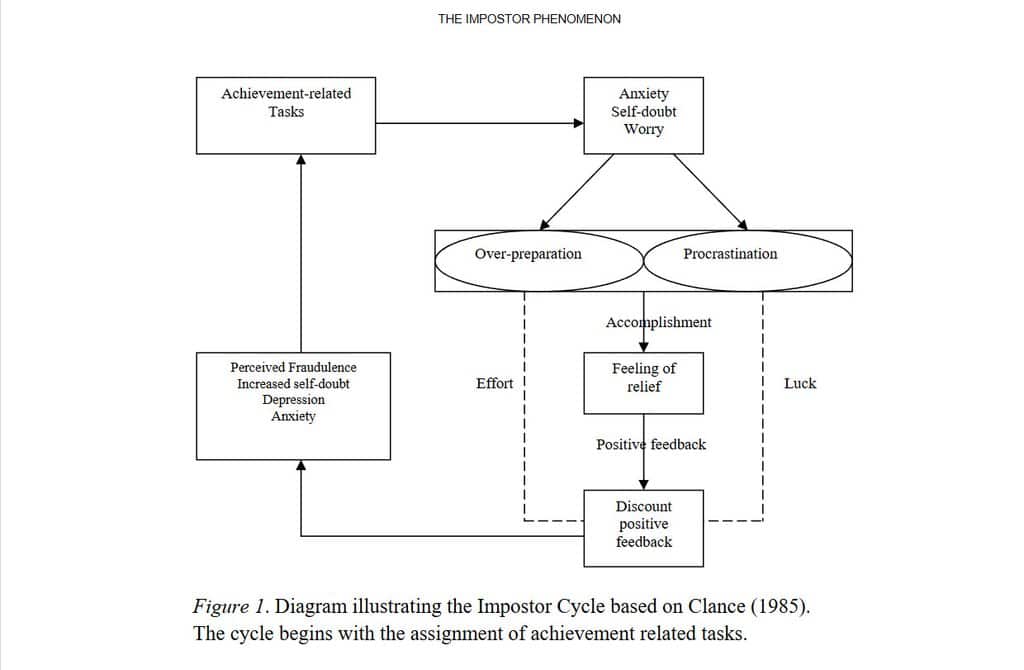
When someone susceptible to the imposter phenomenon gets an “achievement-related task” to perform – like writing an article or a book – the task triggers anxiety, self-doubt, and worry. Those feelings lead the individual to either overprepare for the task (excessive research, anyone?) or procrastinate in other ways.
Once the individual achieves the task, they feel relieved. Positive feedback results. Yay!
And yet the individual finds ways to discount that feedback (like Maya Angelou doubting herself after ELEVEN books) and feels like a fraud.
The cycle repeats.
Coping with Your Inner Critic
Don’t let the fact that writing titans like Angelou and Steinbeck suffered from imposter syndrome dissuade you from writing.
Let’s learn from them and others instead. Here are a few ways you can manage your inner critic so you can write:
- Park your thoughts. Steinbeck’s quote above comes from his book Working Days, a journal he kept while writing The Grapes of Wrath. In it he confided his self-doubt, paranoia, and obstacles. Once he expelled them to a page, he could turn to writing the book. He does this repeatedly.
This is akin to Julia Cameron’s “morning pages” exercise in her book The Artist’s Way. She advised any artist to begin their day writing three pages of whatever is on their mind. The daily upfront mind-clearing allows the artist to proceed. - Recognize and name your inner critic. Julia Cameron calls hers The Censor. Steven Pressfield, author of The War of Art, calls his The Resistance. The name doesn’t matter, but spotting the critic when it shows up does. Once you know it is there, you can deal with it.
- Acknowledge your inner critic and send them packing. Since the critic trades on fear, and takes the cloak of keeping you safe from mistakes, thank the inner critic for their concern and tell them you’ve got it from here today. I say today, because you know they’ll show up again.
- Adopt a draft-mode mentality. No writer sits down at a keyboard and pours forth perfect copy. Tell yourself, truthfully, this is only a draft. Of course you are going to improve it later by editing. This takes the pressure off.
This is Steven Pressfield’s modus operandi. He has authored 11 books, including The Legend of Bagger Vance.
In The War of Art, Pressfield shares his writing routine:
“I sit down and plunge in. When I start making typos, I know I’m getting tired. That’s four hours or so…I wrap for the day…How many pages have I produced? I don’t care. Are they any good? I don’t even think about it. All that matters is that I have put in my time and hit it with all I’ve got.”
Anne Lamott calls this approach the “sh*tty first draft” in her writing advice book, Bird by Bird. I love this. - Find community. Writing is less scary when you aren’t doing it alone. Find a writer’s group or even just one writer friend with whom you can get together and craft prose. Or check in with each other periodically about how your writing is going and any snafus you’ve hit. This is a large part of my role as a book coach, helping my authors feel supported and not alone as they write.
How I Stare Down My Inner Critic
The strategies above work. I know from personal experience.
I write morning pages every weekday. They clear my mind of anything I woke up ruminating on. They allow me to express joys and air grievances. Most importantly, they reassure me that I no longer need to keep all that stuff in my head because it is now recorded somewhere for my eyes only.
A draft-mode mentality serves as my default for everything I write. The relief I felt once I discovered this way of thinking has freed up so much energy.
I’ve not named my inner critic, but I recognize her when she shows up. More than once when I was writing my book, I caught myself audibly saying STFU. A boisterous inner critic brings out the Brooklyn in me. My way of sending her packing.
I am enormously grateful for my writer friends. They commiserate with me when things are rough, celebrate my successes, and cheer me on. And I am there for them. A conversation with anyone of them uplifts and re-energizes me. I can’t say enough good things about finding a writing community.
The combination of all of the above powered me through the writing and publishing of my book.
My advice to the reader who thoughtfully sent the comment was to jot the ideas down and not worry about their being good enough. The act of writing them down – even in fragment form – can progress your thinking.
In other words, instead of waiting until thoughts feel good enough, use the drafting process to develop them. The act of writing often helps clarify your ideas better than mulling them just in your head.
Have you tangled with your inner critic? What strategies to get past it work for you?
Recommended Reads
Nonfiction recommendation: The War of Art: Break Through the Blocks and Win Your Inner Creative Battles, Steven Pressfield

For me, Steven Pressfield is the OG for exposing and dealing with your inner critic. (Though had I discovered Julia Cameron’s The Artist’s Way before The War of Art, I’d have them both here.) He details his struggles with The Resistance, the myriad ways it entices us to procrastinate, and how he manages to write despite all that. When my inner critic is especially loud, I’ll pull the book off my shelf and read to help quiet it.
Fiction recommendation: The Help, Kathryn Stockett
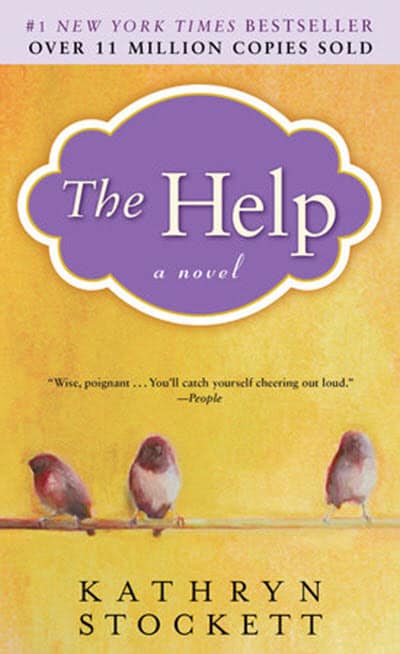
This is Kathryn Stockett’s debut novel, and includes two writers finding their voices together among its story lines. While the book stirred some controversy about appropriation – the story of the Black maids is told from a white perspective – I was bowled over by the novel when I first read it and the story has stayed with me.
Just for Fun
Watch Jason Sudeikus talk about his imposter syndrome after getting hired as a writer for SNL. (1 minute, 57 seconds)
In my research, I learned that even after three seasons, some of Sudeikus' Ted Lasso co-stars still get imposter syndrome.
I also learned that Sudeikus headlines Thundergong!, an annual fundraising event for Steps of Faith, a foundation supporting amputees who need financial support to get prosthetics. And he can sing!
Check out these 3 videos of Ted Lasso stars performing:
“Shallow” (Lady Gaga/Bradley Cooper cover, 3 min 49 seconds)
“Love yourself” (Justin Bieber cover, 7 min 18 seconds – with antics)
“Love Shack” (B52s cover, 5 min 41 seconds)
Enjoy!