Last May Mike Liam from Vermont Book Club reached out to me via my website contact form about featuring my book, Teenage Wastebrand, in one of their “spotlight sessions.” Here's a partial view of his outreach, enlarged for readability.
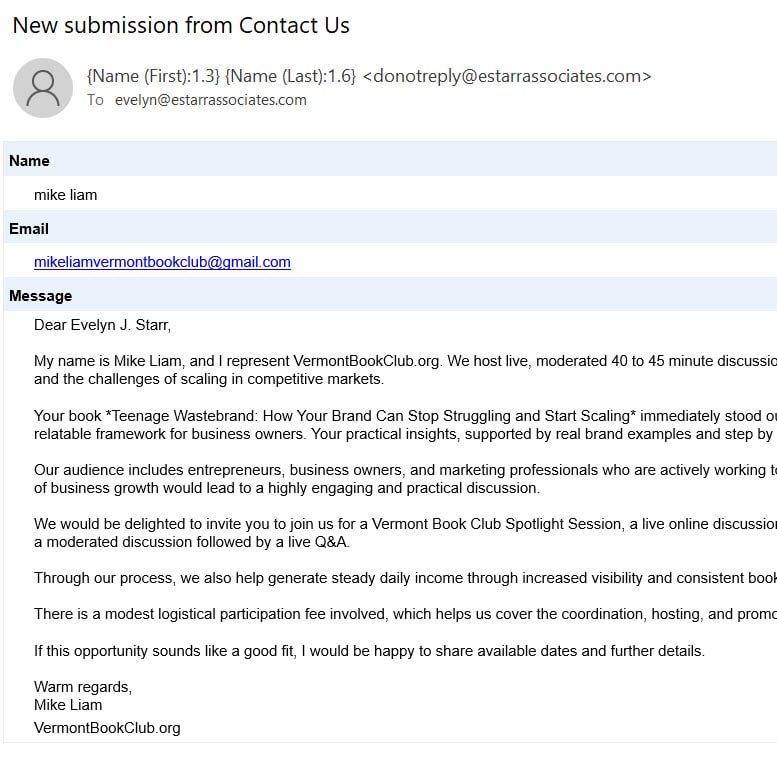
He stated “Our audience includes entrepreneurs, business owners, and marketing professionals…” Great! My target audience.
Of course, there would be a modest fee “which helps us cover the coordination, hosting, and promotional efforts required to feature your work and connect it with our audience.”
I went to the Vermont Book Club website to check them out.
Three hosts appeared on their About page: Josephine Seraphina, Andrew Dennis, and Delaney Vada.
No Mike Liam.
Hmmm. I emailed their support to ask if Mike Liam was associated with them. Twelve minutes later they responded:
Hi Evelyn,
Thank you for reaching out to verify the authenti city of the email. We can confirm that it is legitimate and not an impersonation of our organization. We would be delighted to explore potential opportunities with you.
Kindly proceed with the instructions provided in the email you received. Once everything is finalized, we will be happy to feature your book on our website.
Thanks
Support Team
I replied to ask who I was corresponding with. Thirteen minutes later…
Hi Evelyn,
Thank you for your message.
You are currently corresponding with Delaney Vada from the Vermont Book Club support team. I’ll be your point of contact throughout this process and am here to assist you with any questions or next steps.
Please feel free to let me know how I can best support you moving forward.
Best regards,
Support Team
Vermont Book Club
Then I went to the Past Books page on their website to see who they’d hosted in the past. I recognized several well-known authors’ names and titles.
But something seemed off.
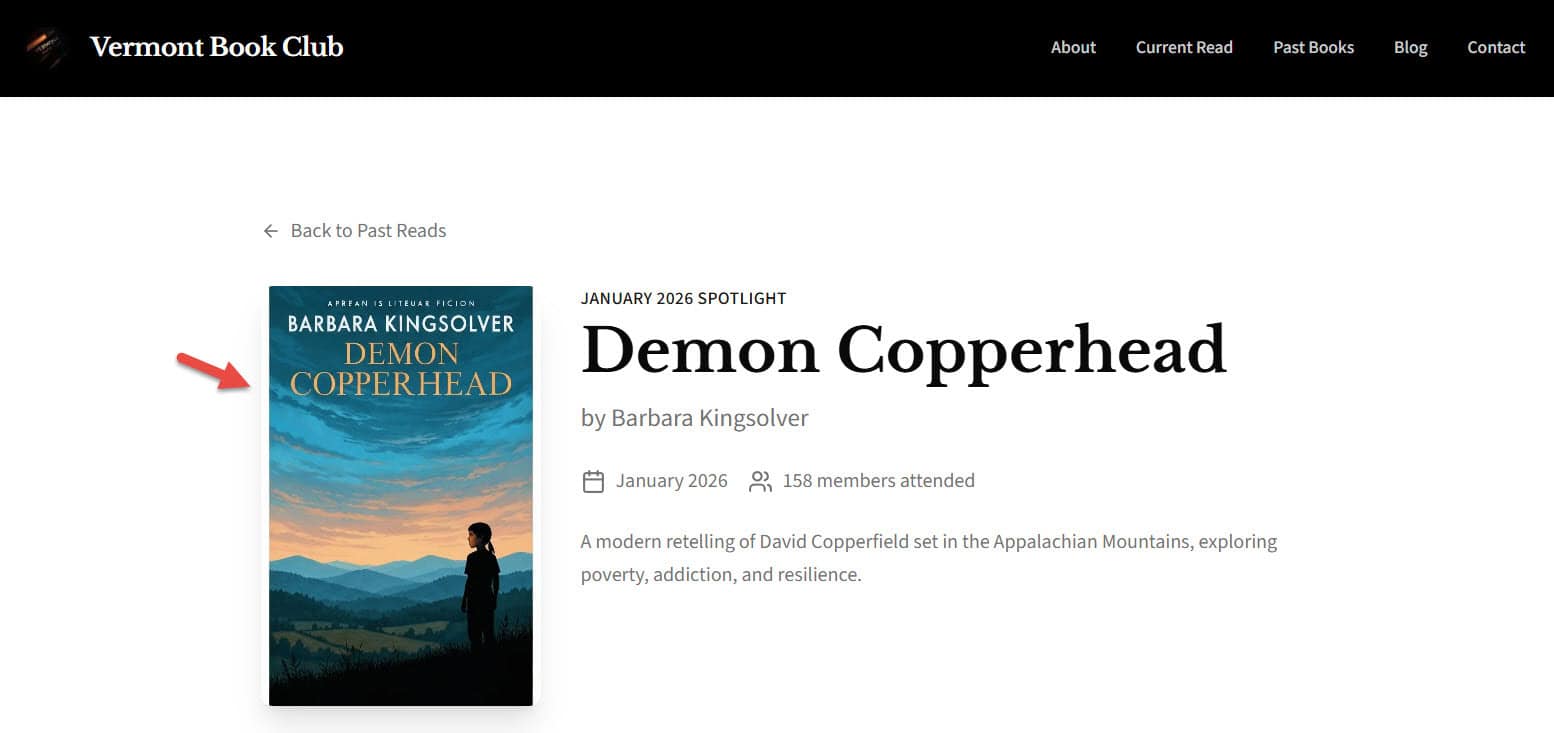
Barbara Kingsolver’s book Demon Copperhead had been featured the prior January. Here’s how it appeared on the website:
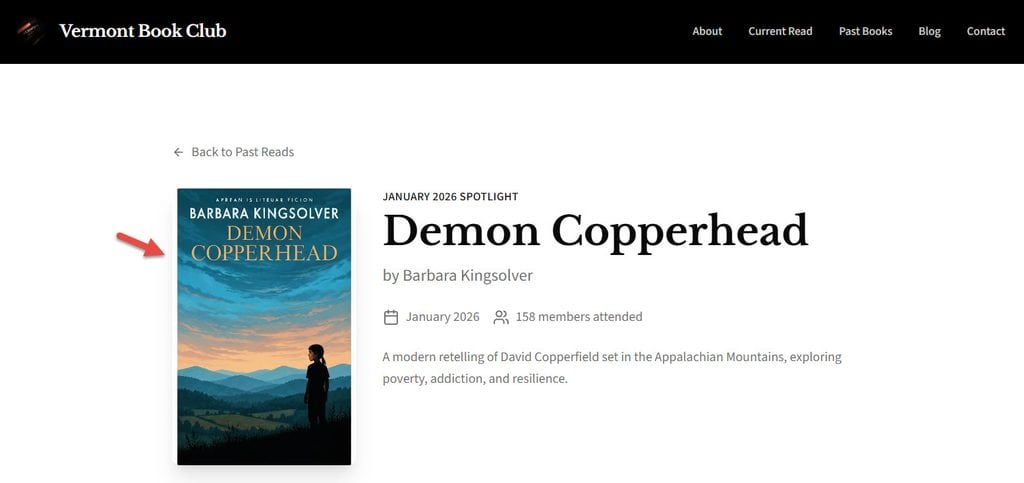
But I remembered the cover as having a white background. A quick look on Amazon showed this cover:
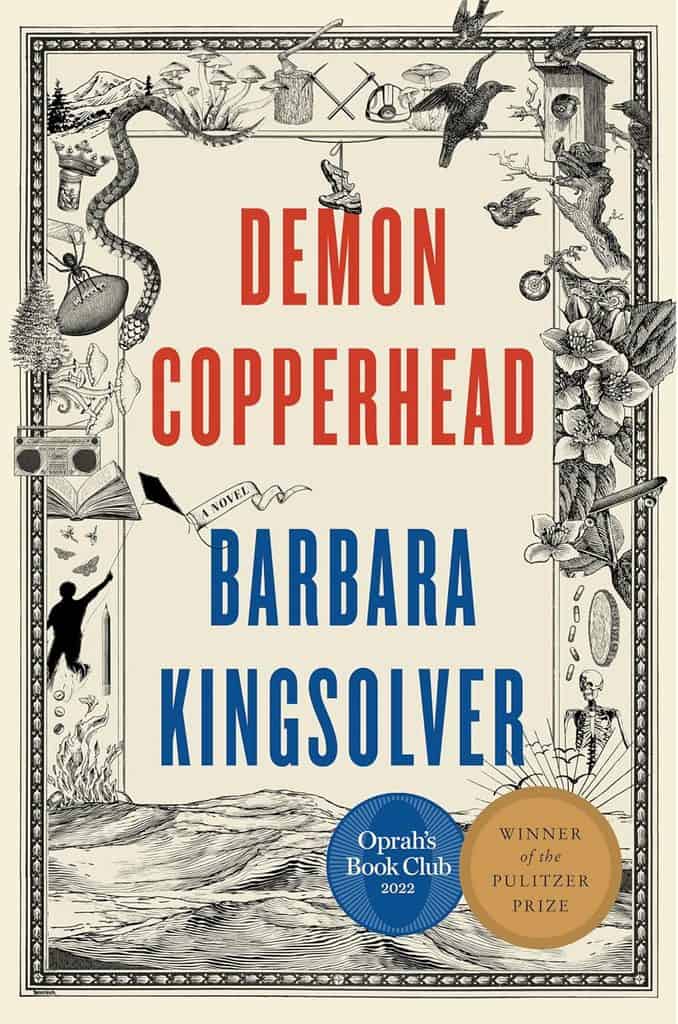
That cover clicked with my memory, and also appeared on the Pulitzer website.
Other featured books I knew did not have the covers I recalled, like The Midnight Library by Matt Haig.
I asked Delaney why their website was not featuring the actual covers of the well-known books they have discussed.
The response 12 hours later:
Hi Evelyn,
That's the cover image provided by the outreach team and the author.
Thanks & Regards
Yeah, right.
The next day another inquiry came through my website. This one from Benjamin Clark who introduced himself as the Director of Outreach for the Vermont Book Club. Included in his 4 paragraphs was this:
“…I am writing to you because your work specifically the groundbreaking framework for identifying and overcoming the adolescent stage of branding carries a rare panoramic authority on the art of strategic narration and the architecture of growth logic which we believe deserves a dedicated professional platform.”
Okay, enough is enough.
There were at least five red flags in those exchanges. Below we’ll see if you caught them all.
AI Makes Tailored Pitches Easier
“A rare panoramic authority on the art of strategic narration and the architecture of growth logic”?
What the heck is that?
Telltale AI slop.
Author scams are nothing new. Sketchy publishers, literary agencies, and bogus promoters have been pitching services to authors by phone and internet for decades.
AI has ramped up the frequency and volume, and introduced more creativity.
I confess I recognized the AI nature of the first inquiry right away.
When I got the second one just a day later, it pissed me off and made me wonder how frequently these inquiries would arrive.
I decided to investigate further. And to do what writers do when they get annoyed: write about it.
What The Scam Delivered
I reached out to four less well-known authors listed on Vermont Book Club’s Past Authors page and asked about their experiences with the club.
Jim Walker paid $150 for “production and technical costs” and liked his experience discussing his book Kenya Safari: A Guide for the First-Time Visitor. His interview lasted 45 minutes, and he said he worked with Madison Luna. The session had 175 members on Zoom and Walker felt it gave him a little more recognition with his book.
“The only issue I had was that the interviewer had such an accent, Spanish I believe, that it was sometimes hard to understand the questions,” he said.
Dr. James E. Hamer enjoyed his session sharing his book Heaven on Earth: Life Now and Hereafter and answering questions, but wasn’t sure it sold any books.
Another author shared that he paid $160 for a session for a different book than the one listed on the Past Author page. The organizers told him there were over 150 people on the call and sent him their email addresses for follow up after the session.
But not one attendee responded to his emails, and he had no way of verifying the addresses.
Dr. Bob Rich paid $130 for a session for his book The Hole in Your Life: Grief and Bereavement. His experience disappointed him enough to write about it on his blog.
He suspected the attendees might have been AI Avatars. I think he is right.
I got to watch his session before the video became unavailable. I suspect the moderator might have been AI generated as well.
Signs of an AI-Generated Author Scam
Please know I do not begrudge the enjoyment Mr. Walker and Dr. Hamer got out of their sessions. I am happy for them.
But I still believe this is a scam.
Let’s look at the tells in the original inquiry that tipped me off.
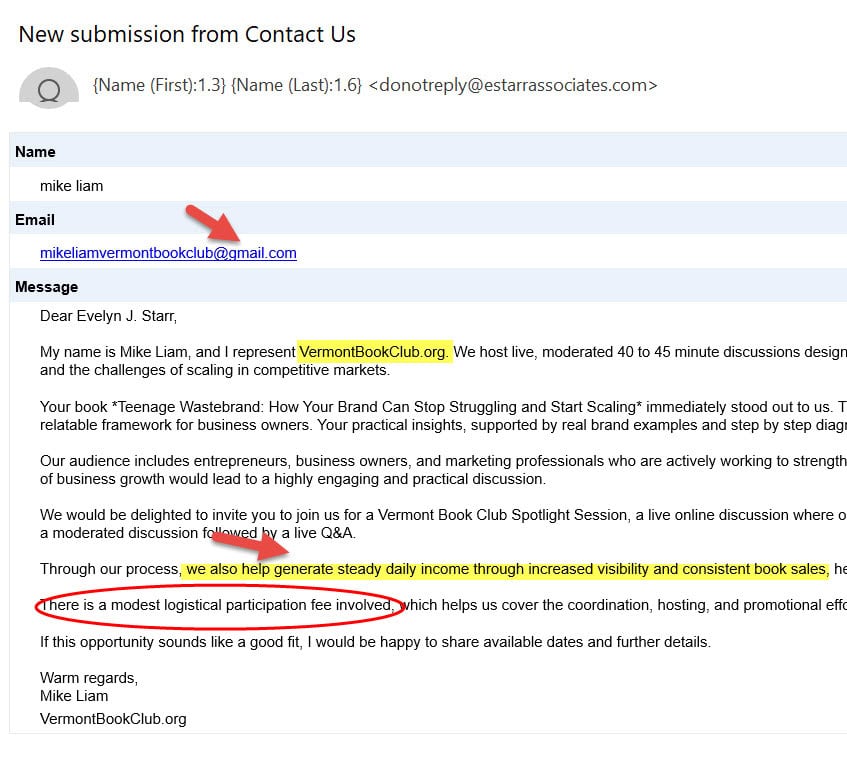
- The sender entered a gmail address, rather than one with the Vermont Book Club domain address.
- They promised to generate steady daily income. No one can guarantee that, and it is unlikely to come from a book club appearance.
- They asked for a modest fee. Authors should not have to pay for a book club appearance.
- They sent gobbledygook praise for my book. The AI-generated giveaway was more prominent in the second email as I showed above.The first email’s narrative was better, but still not believable to me as it sounded like my book description rephrased.
My email relays with support, website visit, and past author research revealed more tells.
- Support replies were never signed by a specific person. Even after I asked who I was emailing with.
- The website listed the wrong book for an author’s session. AI grabbed the wrong one.
- The website displayed bogus covers for prominent authors’ works. It’s laughable that Barbara Kingsolver, Matt Haig, Bonnie Garmus (Lessons in Chemistry), and Amor Towles (The Lincoln Highway) would have paid for a session.
- Viewers never saw the moderator nor any of the attendees in Bob Rich’s session. The moderator’s voice was stilted and somewhat robotic.
- None of the people listed on the website or in the outreach emails were findable on LinkedIn. Most professionals doing outreach have profiles there.
This is only one of the scams that fill writers’ inboxes several times a week.
Protect yourself by knowing the warning signs above. You can find more information and tales of scam at these excellent writer resources:
- The Alliance of Independent Authors – “Spammers and Scammers: How to Spot a Publishing Scam in 2026”
- Jane Friedman: “No, Colleen Hoover Did Not Email Me: Current Scams Targeting Authors”
- SHuSH (newsletter of publisher The Sutherland House, Inc.): “The Season of Scam”– scroll down a bit to find the tale
- Writer Beware
Have you experienced an author scam pitch?
Recommended Reads
As a voracious reader, I LOVE to talk about books. In each newsletter I will recommend a nonfiction book and a novel, aka a fiction book.
Nonfiction recommendation: Bad Blood: Secrets and Lies in a Silicon Valley Startup by John Carreyrou
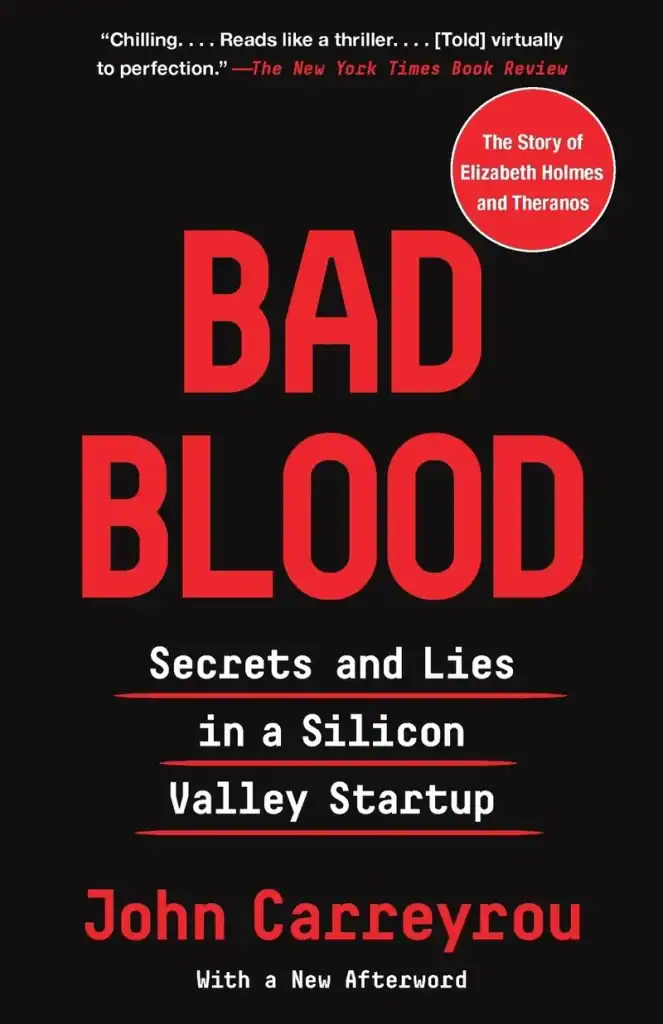
Bad Blood is not an AI-generated-scam tale, but a riveting book detailing how Stanford student dropout Elizabeth Holmes built her blood test company Theranos to a valuation of over $9 billion before her scheme unraveled.
Holmes claimed technology that allowed faster, cheaper blood tests with just a pinprick’s worth of blood.
Among those she swindled: Henry Kissenger, Rupert Murdock, and former U.S. Secretary of State George Schultz.
Fiction recommendation: The Firm, John Grisham
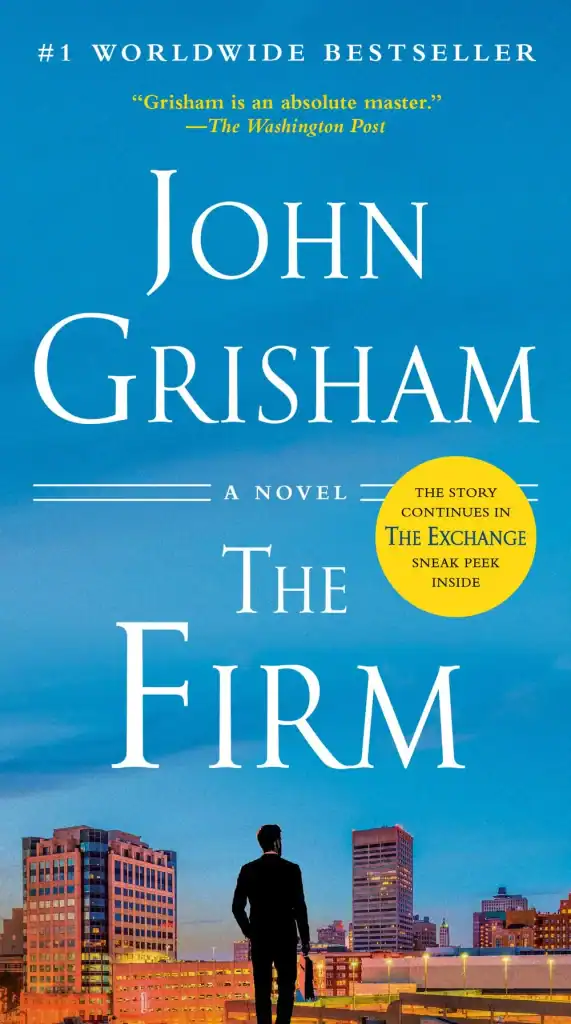
John Grisham’s second legal thriller features Harvard Law school graduate Mitch McDeere, who joins a top law firm in Memphis. When he discovers the firm’s illegal activities, he must navigate between his ethical obligation to protect client confidentiality and his desire to protect his family, and FBI pressure to expose the both the firm and the Mafia.
Read the book or enjoy the movie, starring Tom Cruise as Mitch, and featuring Holly Hunter, Jean Tripplehorn, and Gene Hackman.
And David Strathairn, who seems to show up in a ton of movies and still fly under the radar. Bet you recognize him immediately.
Just for Fun
SNL loves a scam. Enjoy this skit with Kate McKinnon as she portrays Theresa Caputo, Long Island Medium.
…and this one for Old Glory Insurance